You're probably in the same spot many find themselves in before an anniversary, birthday, or wedding gift. You want something personal, but not cheesy. You want it to feel thoughtful, not like a panic purchase from a gift guide that recommends the same candle, watch, or photo frame to everyone.
That's why a Where We Met map gift works so well. It doesn't just say “I remembered the date.” It says “I remembered the place, the context, and why that moment mattered.” That difference is huge. A good map gift turns a memory into a physical object you'll keep seeing long after the flowers are gone and the dinner reservation is forgotten.
Table of Contents
- A Gift That Tells Your Story
- Pinpointing Your Story's Starting Point
- Designing a Map That Tells Your Story
- From Digital Design to Physical Artwork
- Perfecting the Grand Reveal
- Your Map Gift Questions Answered
A Gift That Tells Your Story
Most gifts fail for one simple reason. They're about the occasion, not the memory.
A Where We Met map gift flips that. Instead of buying something generically romantic, you anchor the gift to the exact place where your story started. That could be a cafe, a train platform, a bookstore aisle, or the sidewalk outside a bar you almost didn't go into. The point isn't that the location was glamorous. The point is that it became important because it was yours.
That instinct toward personalization isn't random. The global gift retailing market reached USD 100.33 billion in 2026, driven by buyers choosing milestone-based, personal gifts over generic presents, according to Mordor Intelligence's gift retailing market report. People want gifts that feel specific because specific gifts last.
A map works when it captures a turning point, not just an address.
What I like about this gift is that it sits in that rare middle ground. It's emotional, but still clean enough to live on a wall. It tells a story without needing a paragraph of explanation every time someone sees it.
If you're building a full gift around it, pair the map with one grounded object rather than a pile of themed extras. For couples who enjoy ritual and hosting, something like these curated whiskey glass collections can complement the map without competing with it. The map holds the memory. The second item supports the way they live now.
Pinpointing Your Story's Starting Point
The location is the whole gift. Get that wrong, and everything else feels off.
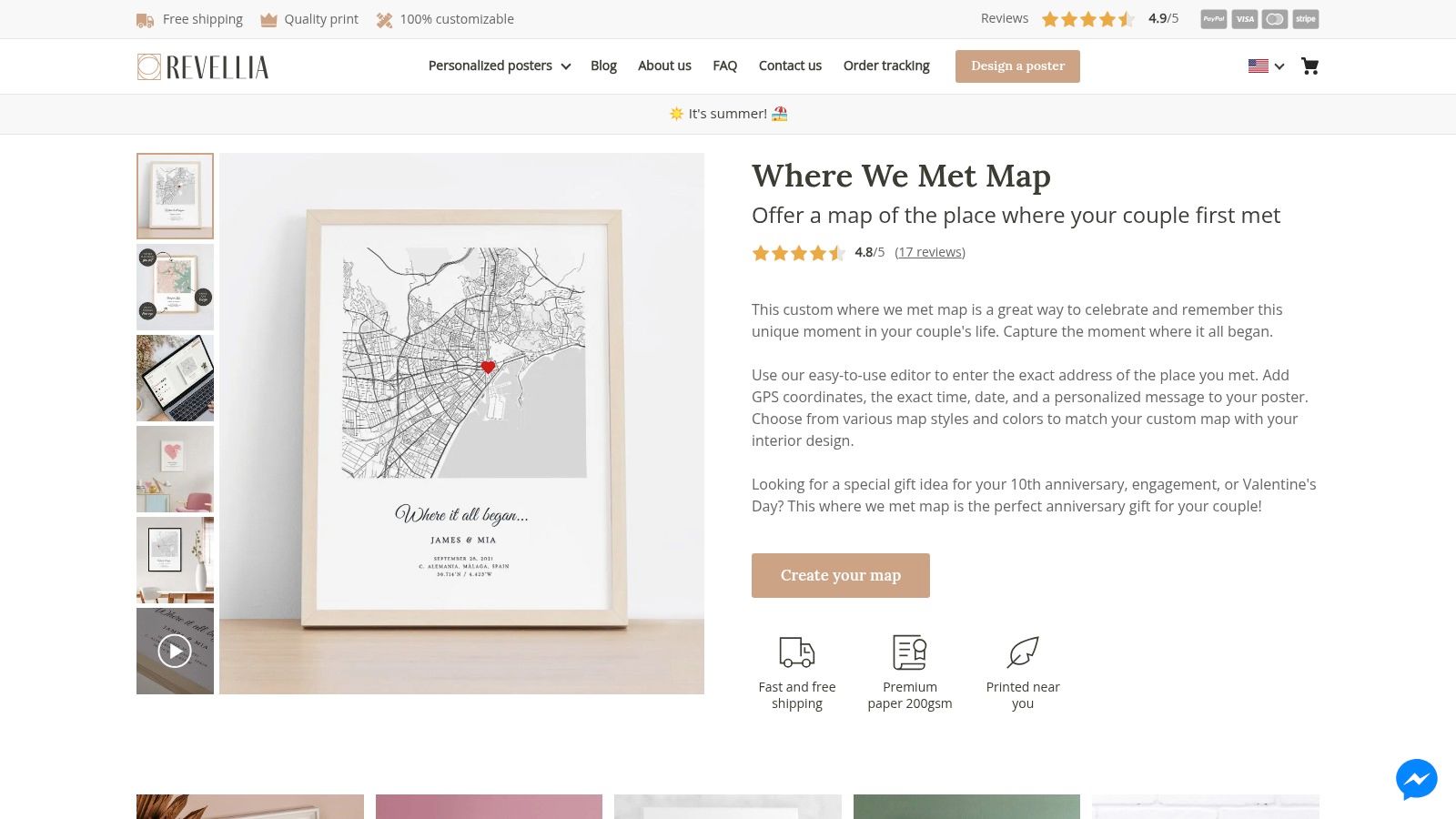
A lot of people type in a city name, see a decent preview, and move on. Don't do that. If the memory happened at a particular corner, entrance, bench, or building, the map should reflect that exact place. That's what makes the final piece feel intimate instead of approximate.
Pick the place, not the city
The strongest map gifts answer a very human question. Where exactly did it happen?
Not “Paris.” Not “downtown Chicago.” Not “that neighborhood near the river.” You want the first place that holds emotional weight. Maybe it was the restaurant where you talked for three hours, but perhaps it was the curb outside afterward where the night changed. Those are different stories.
Use this quick filter:
- If the relationship began indoors, use the venue address.
- If the memory is tied to an outdoor moment, use the path, overlook, gate, or intersection that best represents it.
- If the first meeting and first spark were different, choose the one that matters more emotionally.
Use coordinates when the memory deserves precision
Cutting corners on location accuracy frequently results in disappointment. A 2024 study found that 72% of users consider exact location accuracy the top factor in how meaningful a personalized gift feels, and 92% of customer dissatisfaction with map gifts comes from location errors caused by using general city names instead of exact coordinates, as noted on Positive Prints' where we met map product page.
That aligns with how these gifts land in real life. If the marker lands a few streets away, the recipient notices. They might not say it out loud, but they notice.
The safer route is simple:
- Start with the known address if you have it.
- Open a map and zoom all the way in until you can identify the exact building or spot.
- Drop a pin manually rather than trusting autofill.
- Save the coordinates if the editor allows it, especially for parks, beaches, or places without a clean postal address.
Another technical detail matters more than most product pages admit. Accurate map generation works best when you provide exact latitude and longitude within ±0.001° tolerance and the exact timestamp in UTC for any associated celestial detail, based on the methodology described by Maps of the World. That sounds nerdy, but the reason is simple. Specific inputs produce a map that feels deliberate.
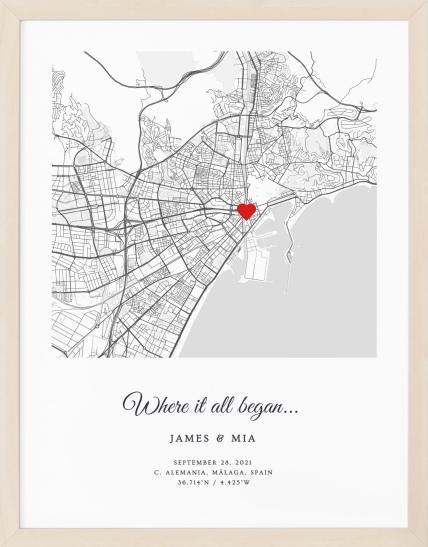
One factual option in this category is the Personalized where we met map, which is a personalized map of the place where you first met.
Practical rule: If you'd be disappointed seeing the pin one block away, you need coordinates, not just a city name.
Decide what the marker is really saying
The marker does more than identify a spot. It tells the viewer what part of the memory matters most.
A marker placed directly on the building says, “This exact place changed everything.” A marker placed on the surrounding block says, “This whole setting is part of the story.” Neither is wrong. But you should choose on purpose.
If your story is private and hyper-specific, zoom in tighter. If the feeling was bigger than the venue, pull back enough to include the streets or landmarks that made the moment what it was. That little framing choice changes the emotional read of the finished piece more than people expect.
Designing a Map That Tells Your Story
Once the location is right, design stops being decoration and starts becoming interpretation. The map gives you facts. The styling gives those facts a tone.
A lot of people overload these gifts because they're nervous that the memory won't come through on its own. It will. Your job is to support it, not smother it.
Choose a style that matches the relationship
Don't pick colors because they're trendy. Pick them because they sound like the relationship when translated into visuals.
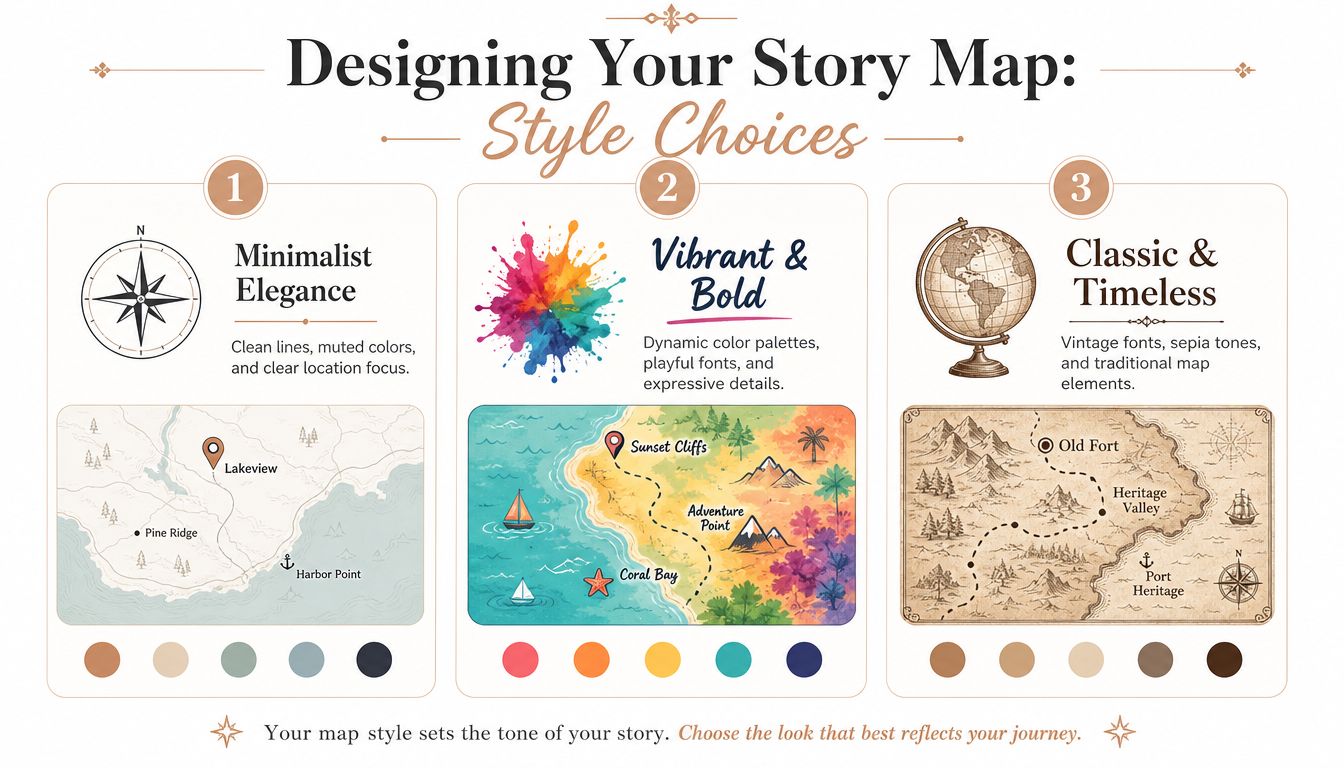
Here's the simplest way to understand it:
| Style | Best for | Emotional effect |
|---|---|---|
| Minimalist | Quiet, modern homes and understated couples | Calm, elegant, reflective |
| Bold | Playful personalities and colorful interiors | Energetic, expressive, young |
| Classic | Traditional spaces and milestone gifts | Warm, established, timeless |
If you're stuck, look at the room first. The gift should feel like it belongs in their home, not like it wandered in from someone else's Pinterest board.
There's a similar logic in jewelry. Symbolism works best when the form matches the story, not when it's just pretty. This guide on how to choose jewelry symbols for your story is useful for that same reason. It shows how personal meaning gets stronger when design choices come from memory, not habit.
Write text that adds meaning, not clutter
The text should do one job. It should help the map speak faster.
Good titles usually fall into one of three lanes:
Straightforward
“Where We Met”
“The Place We Met”
“Our Beginning”Sentimental
“Where It All Began”
“The Night Everything Changed”
“Our First Chapter”Playful
“Bad Idea. Great Outcome.”
“One Random Tuesday”
“The Plot Twist”
Then add the names and date. That's usually enough.
The best wording sounds like something the two of you would actually say.
If you want one extra line, make it short. A phrase like “First date, late coffee, no chance we were leaving after one hour” can work if the rest of the design is restrained. But don't turn the poster into a diary entry. The visual should still lead.
Think like an editor, not a scrapbooker
A strong map gift has hierarchy. You notice the place first, then the title, then the supporting details.
That means making decisions such as:
- Keep one focal point. The map should dominate.
- Use one emotional phrase. More than one usually weakens both.
- Limit font mixing. Too many styles makes the piece feel homemade in the wrong way.
- Leave some breathing room. Empty space gives the memory weight.
This is the difference between sentimental and cluttered. Sentimental feels considered. Cluttered feels anxious.
If you want the piece to age well, lean simpler than your first instinct. Loud designs impress on screen. Cleaner designs live better on walls.
From Digital Design to Physical Artwork
A beautiful preview means nothing if the physical print feels flimsy. This is the stage where the gift either becomes art or stays a file you once liked on a screen.
Material changes the mood
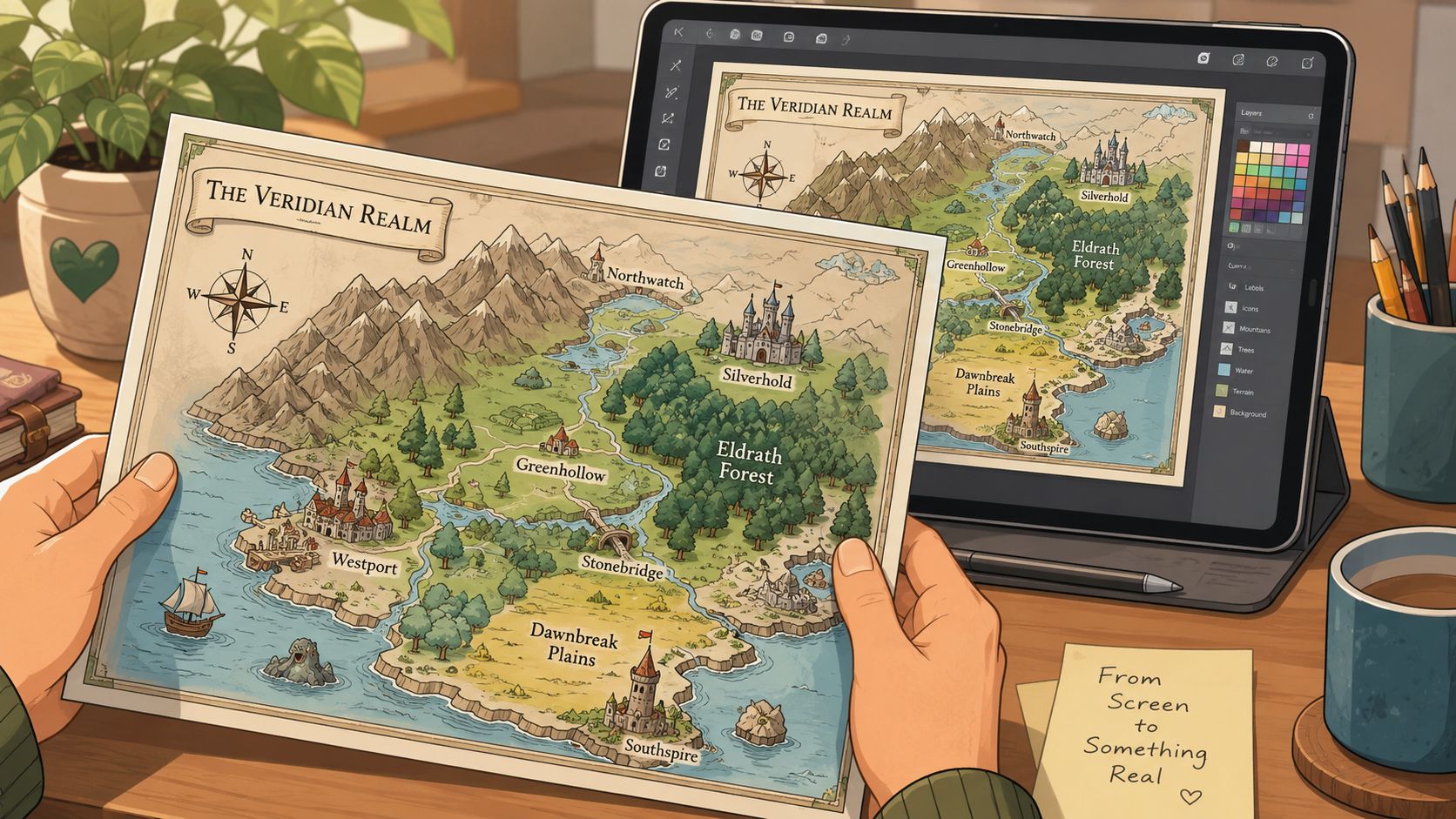
Paper, finish, and print quality all affect how the gift is received. Matte paper usually works best for map art because it keeps the design readable and avoids the shiny, poster-store look that can cheapen something personal.
Revellia describes its prints as being produced on museum-quality matte paper, and that matters for a gift like this. You're not buying disposable decor. You're preserving a memory that's supposed to stay in view for years.
Cheap materials make sentimental gifts feel temporary.
On-demand production also makes sense for this category. It avoids mass inventory and fits the whole point of the gift, which is that it's made for one specific story, not for everyone.
Size should match the moment
Don't choose size based only on wall space. Choose it based on emotional importance.
A smaller print works when the gift is intimate and quiet, something for a bedroom wall, hallway, or shelf display. A larger format makes sense when the map marks a major milestone such as an engagement, wedding, or first home. The bigger the emotional role you want it to play in the room, the more visual presence it needs.
A good question to ask is: will this be discovered up close, or noticed across the room?
Framing is part of the gift
Framing changes the message. An unframed print says, “I made something meaningful.” A framed print says, “I finished the thought.”
That's why I usually recommend framing if this is meant to be opened on a special day. It removes friction, looks complete immediately, and makes the reveal stronger. If you're framing it yourself, keep the frame simple. Black, white, natural wood, or a muted metallic finish will usually age better than anything ornate.
If sustainability matters to you, FSC-certified wood and print-to-order workflows are worth choosing when available. They fit the spirit of a gift that's meant to be intentional from start to finish.
Perfecting the Grand Reveal
The reveal can lift this gift from touching to unforgettable. You don't need theatrics. You need context.
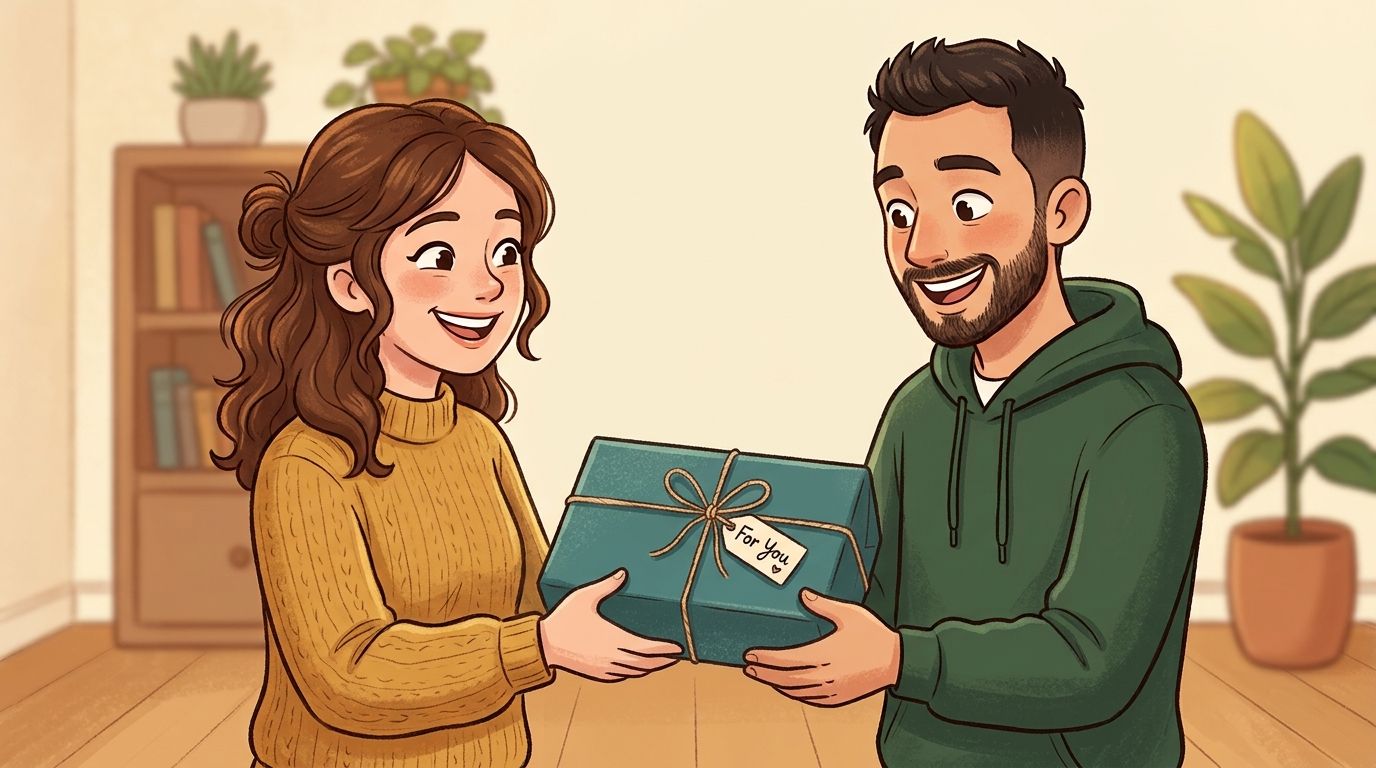
Too many people hand over the tube and say, “Open this.” That wastes half the emotional potential. A map gift lands hardest when the recipient gets one beat to remember before they see the design.
Give it with context
You don't need a speech. One sentence is enough.
Try something like:
- “I wanted to give you the exact place where everything changed.”
- “I keep thinking about how ordinary that place looked before it became ours.”
- “This is the spot that turned into the rest of our life.”
Those lines work because they direct attention to the memory before the object. That's the order you want.
There's also the practical side. Revellia's production model notes delivery windows that are typically within 3 to 7 business days, with localized printing through a network of partners in multiple countries. That can help with gift timing, but I still recommend ordering early. A meaningful gift shouldn't be riding on your luck.
Make the presentation feel intentional
The strongest reveal ideas are usually simple:
- Frame it before gifting so it can be seen instantly.
- Hide it in the place the memory connects to, such as the hallway near your front door or above the dining table.
- Pair it with a note, not a long letter. A few lines beat a page of explanation.
- Build a quiet scavenger trail using clues tied to the first date, first message, or first shared place.
One of my favorite approaches is the delayed reveal. You go out to dinner, come home, and the framed map is already hanging where they'll spot it naturally. That feels less like a product exchange and more like a moment.
Plain wrapping also helps. If the gift itself is emotional, the packaging should stay out of the way.
Your Map Gift Questions Answered
Some questions only show up once you're about to order. Here are the ones that matter most.
What if I don't know the exact address
Work backward from the memory. Search old messages, calendar entries, photos, ride receipts, or email confirmations. If you still can't find the exact address, use the closest confidently known point and choose a map zoom level that supports that uncertainty rather than pretending it doesn't exist.
If the memory happened in a park, festival area, beach, or campus, drop a pin on the part of the space that best represents the moment. In this gift category, honesty beats fake precision.
Can this be used for other milestones
Yes, and some of the strongest map gifts aren't about the first meeting at all.
They can mark:
- A first date that mattered more than the official introduction
- A proposal location that deserves its own wall art
- A wedding venue when you want something quieter than another photo
- A first home if the gift is about building a life, not just starting one
The same design logic applies. Pick the place with the strongest emotional charge, then design around that story.
Will a map work for unusual or international locations
Usually, yes. The concept isn't limited to major cities. Rural areas, coastlines, small towns, mountain roads, and international addresses can all carry just as much weight.
The key is choosing the right framing. If the exact site is isolated, zoom out enough to give the location visual context. If the place is dense and urban, zoom in enough to avoid noise.
If the location matters to the two of you, it's map-worthy.
How should I handle packaging and timing
If you're gifting an unframed print, have a plan before it arrives. Leaving it in the shipping tube for days kills momentum and increases the odds that the gift feels unfinished.
For framed or ready-to-display options, inspect the package early if you can. Don't save the first look for five minutes before dinner. Give yourself time to check the text, location, and presentation details with a calm brain.
If timing gets tight, choose the simplest version that still feels complete. A clean design, solid print, and thoughtful note beat an overcomplicated concept rushed at the last second.
If you want a straightforward way to turn a meaningful place into wall art, Revellia is built around personalized prints you can customize in the browser, including map-based designs tied to specific memories. Keep your version simple, accurate, and emotionally honest. That's what makes this gift stick.