That big, blank wall usually becomes a decorating stalemate. You know it matters, you know a tiny framed print will disappear on it, and you also know you don't want to spend money on something generic that says nothing about your life. So the wall stays empty.
I see this all the time in homes with open-plan living rooms, above long sideboards, behind dining tables, and on the full-height wall at the top of a staircase. The mistake isn't usually style. It's scale, and then story. People either go too small, or they choose something large that fills space but feels emotionally flat.
This is exactly why personalized, data-driven art works so well on oversized surfaces. A meaningful date, a location, a birth detail, a word your family uses, or a timeline of real milestones gives the wall a job beyond decoration. It becomes a room anchor and a conversation piece at the same time. That direction also fits where the category is moving. The global wall art market is projected to grow from $70.94 billion in 2026 to $145.49 billion by 2034, with North America holding a 43.60% share in 2025, according to Fortune Business Insights' wall art market outlook.
Large-scale pieces are especially relevant right now because oversized wall art remains the leading interior expression trend in 2026, with guidance to size art at about 60% to 75% of the furniture width beneath it and hang the center around 57 to 60 inches from the floor, as noted in 2026 wall art trend guidance from Extra Large Wall Art. If you're looking for wall art ideas for large wall areas, start with pieces that carry your own data and your own story.
Table of Contents
- 1. Personalized Star Map Prints
- 2. Custom Where We Met Location Maps
- 3. Moon Phase Calendar Posters
- 4. Custom Family Portrait Illustrations
- 5. Personalized Birth Announcement Posters
- 6. Custom City Map and Skyline Prints
- 7. Definition and Word Art Posters
- 8. Astrology and Zodiac Sign Personalized Prints
- 9. Timeline and Milestone Gallery Walls
- 10. Large-Format Statement Pieces
- 10 Large-Wall Art Ideas Comparison
- From Blank Space to Personal Statement
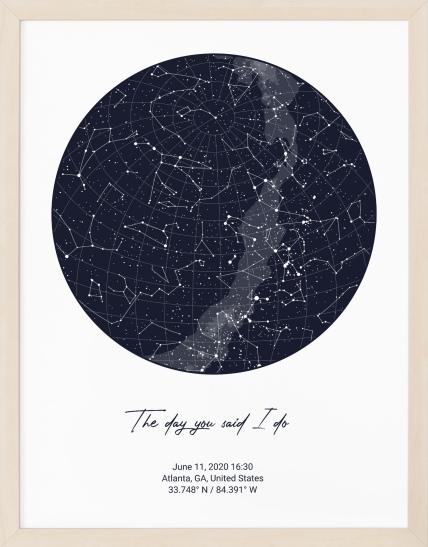
1. Personalized Star Map Prints
A star map works when you want the wall to feel intimate without looking sentimental in an obvious way. It takes a date, time, and location, then turns that exact sky into artwork. For a large wall, that's powerful because the design already carries visual structure. You aren't forcing meaning onto an abstract print. The meaning is built in.
Good occasions are easy to identify. Wedding night. The evening you got engaged. A child's birth. The last night in a first apartment before a big move. Memorial pieces can work too, especially in quieter spaces like bedrooms or reading rooms.
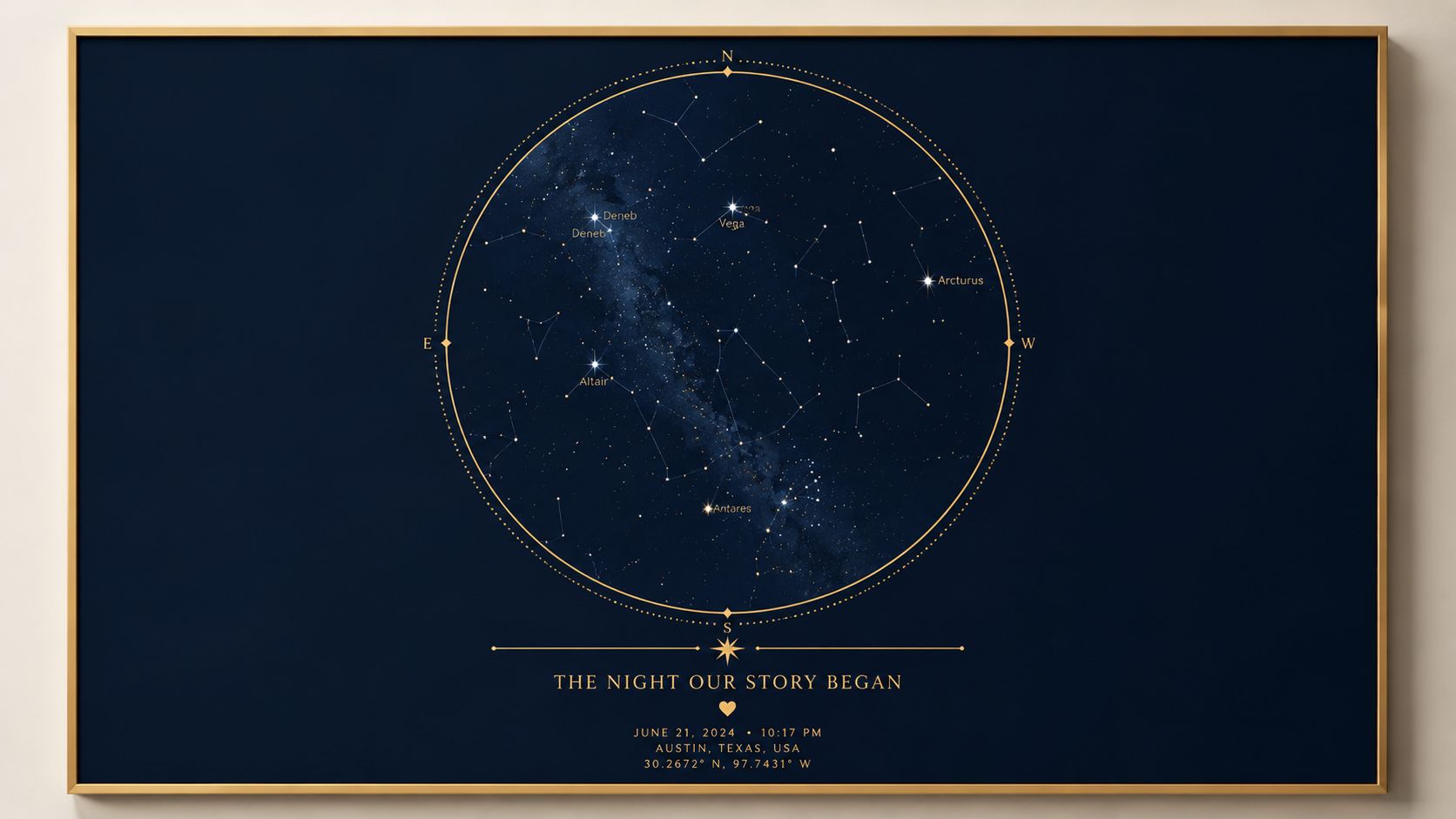
A factual product example is this Personalized star map, described as a star map poster recreating the night sky for a special moment. That kind of piece suits oversized placement because the circular sky layout reads clearly from across the room.
Best placement and styling
Use a single large star map above a bed, a sofa, or a long console. If the wall is extra wide, a pair or trio can work well when each print marks a separate milestone in chronological order. Keep the frames consistent. Changing frame color from print to print usually weakens the story.
What works best:
- Use the exact time: If the moment matters, don't round the hour. The more specific the data, the more convincing the piece feels.
- Keep the palette restrained: Black, ivory, deep navy, soft beige, or muted sage age better than novelty gradients.
- Give it breathing room: Celestial art looks strongest with negative space around it, not crowded by shelves and sconces.
Practical rule: If the story is deeply personal, let the styling stay calm. The meaning should carry the drama.
What doesn't work is treating star maps like filler in a random gallery wall. They need enough scale to be read as a focal point. On a large wall, that's the whole advantage.
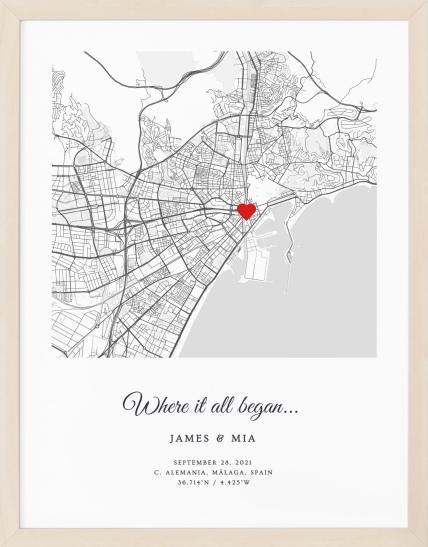
2. Custom Where We Met Location Maps
Some of the best wall art ideas for large wall spaces come from geography, especially when the place changed your life. A "where we met" map has more edge than a generic city print because it's precise. The exact café corner, campus building, beach access point, or cross-street gives the piece emotional credibility.
This idea also adapts well to different relationship stories. A couple who met in college might use a tight street-level crop with the building marked. A long-distance couple might pair the meeting location with current home locations. A destination story can use a wider map view so the surroundings matter.
The most useful product version is a Personalized where we met map, identified as a personalized map of the place where you first met. That's a clean fit for large-scale placement because map graphics can expand without losing their structure.
How to make the map feel personal instead of touristy
The biggest mistake is choosing too broad a zoom. If you only show the city, the piece starts to feel like travel décor. If you show the exact block, intersection, or venue area, it feels like your story.
Strong custom details include:
- Coordinates or address: Useful when the place matters more than the city name.
- A short line of context: "Met over coffee," "first day of class," or "the night everything changed" is enough.
- A date line: Keep it short and secondary so the map remains the hero.
In my experience, these maps work especially well in entryways, dining areas, and above sideboards because people naturally stand close enough to read them.
Keep the label hierarchy simple. Place name first, then date, then any private phrase in the smallest type.
If your room already has a lot of visual texture, choose a minimalist map style. If the room is plain, a map with stronger contrast and a bold marker can hold the wall better.
3. Moon Phase Calendar Posters
A wide bedroom wall often needs more than one focal point. It needs a pattern with enough scale to hold the space. Moon phase calendar posters do that well because they turn a personal timeline into a structured visual sequence. Instead of marking one meaningful date, they map a stretch of time such as a pregnancy, the first twelve months in a new home, a healing year after loss, or the months leading up to a child's birth.
That story-based timeline is what makes this option different.
For large walls, the layout matters as much as the artwork itself. A single small moon print usually gets lost. A horizontal run of phases works well above a bed or bench. A tall grid suits stair landings and narrow wall sections. An arched arrangement can soften a nursery or reading corner, especially if the room has rounded furniture or curved mirrors.
When moon phase art works best
Choose moon phase posters when the duration of the event carries meaning, not just the start date. If the story is about a single night, a star map usually says it more clearly. If the story is about change over weeks or months, lunar phases give you a stronger visual language.
I usually tell clients to decide three things first. How many phases they want to show, how much wall width they need to cover, and whether the text should read from a distance or stay secondary. Those choices control the final scale.
A practical sizing approach looks like this:
- Above a queen or king bed: Use a long horizontal piece or a framed set that spans roughly two-thirds to three-quarters of the bed width.
- Above a dresser or nursery changer: Keep the composition narrower and taller so it doesn't feel squat against the furniture.
- On an open living room wall: Use a larger grid or multi-panel arrangement so the repetition reads from across the room.
- For a date-rich design: Keep the dates, names, or month labels in smaller type and let the moon forms carry the wall visually.
Style matters here, but restraint matters more. Moon phase art already contains repetition, symbolism, and contrast. In monochrome rooms, black, cream, charcoal, or muted metallics let the phases read as texture. In softer interiors, pair them with linen, plaster, boucle, or light wood so the piece feels grounded instead of overly themed.
Texture can improve this category. Raised ink, handmade paper, or layered finishes often suit lunar imagery because the subject has natural depth and shadow, as noted earlier in the article. The trade-off is readability. Heavy texture looks better up close, but a cleaner print usually carries farther on a large wall.
One styling mistake shows up often. People surround moon phase art with too many other celestial motifs. One related piece can work. A wall full of stars, zodiac symbols, constellations, and moons usually starts to feel decorative instead of personal.
Keep the background calm. Let the timeline do the work.
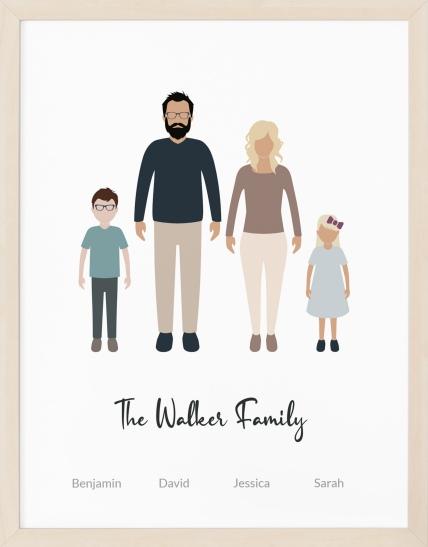
4. Custom Family Portrait Illustrations
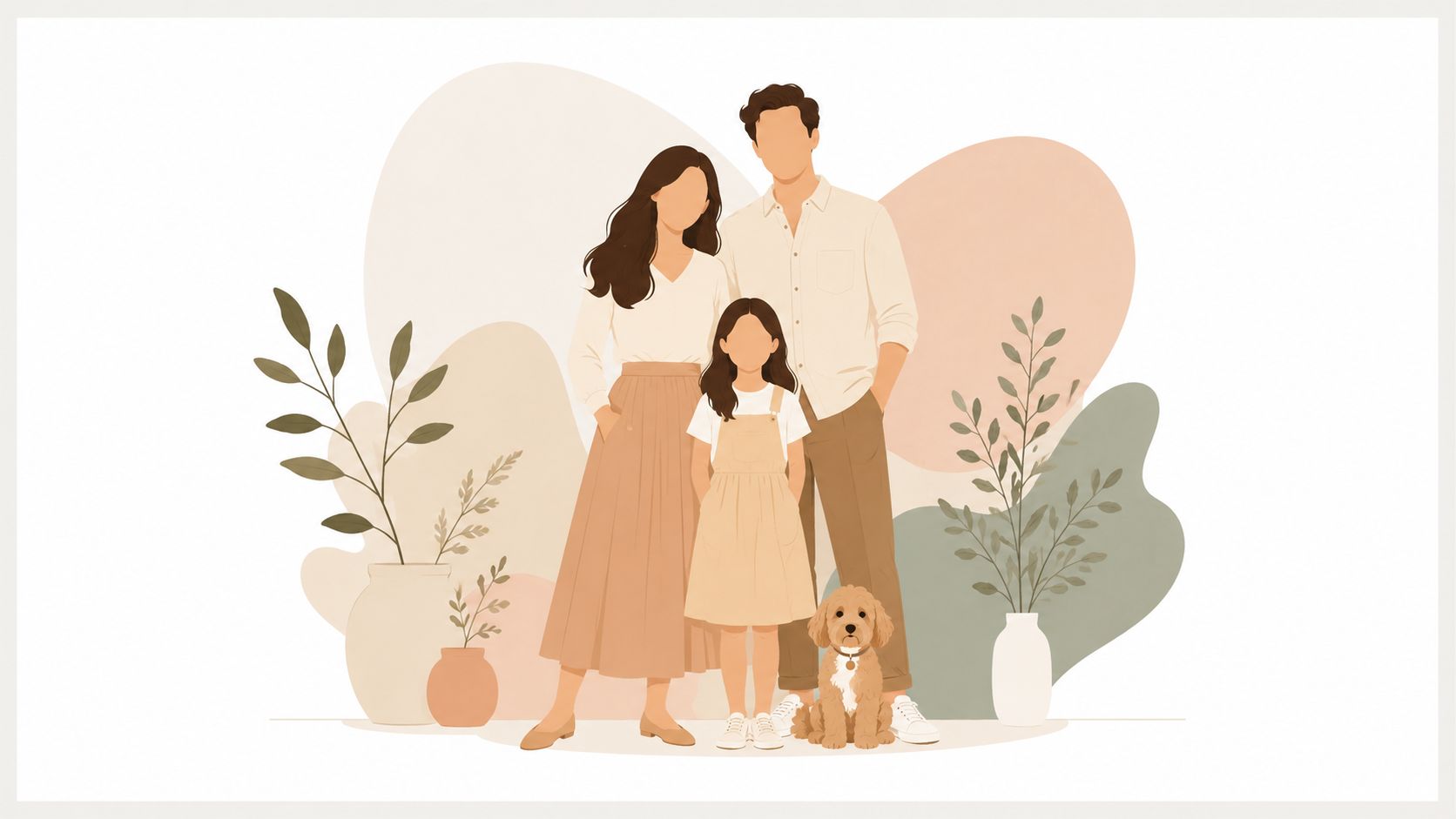
Some families want personal wall art but don't want a traditional photo enlargement. That's where illustrated family portraits earn their place. They keep the identity of the people, but they remove the visual noise of mismatched outfits, awkward backgrounds, and that one expression nobody likes in the original photo.
This option is especially useful for blended families, households with pets, or relatives who rarely get photographed together in one place. You can build a portrait from separate images and still end up with one cohesive large-format piece.
How to get a portrait that still feels elevated
The difference between charming and cheesy usually comes down to editing. Simplify the background. Limit the color story. Decide early whether the portrait should feel playful, minimalist, or sentimental, then keep every decision aligned with that choice.
What I recommend most often:
- Use clear source photos: Similar angles and decent lighting make a major difference.
- Control the clothing palette: Even in illustration, clothing color can dominate the whole wall.
- Add one meaningful detail: A dog, a favorite chair, a family home outline, or a small symbol is enough.
Family portraits look better at scale when the background is quieter than the people.
This is one of the safest choices for a large living room wall because the subject matter already belongs in the home. It doesn't need conceptual explanation. It just needs enough refinement to feel designed, not novelty-driven.
5. Personalized Birth Announcement Posters
Birth announcement posters can absolutely live beyond the nursery. In fact, they often work better when they're designed as family keepsakes rather than baby-themed decorations. A large wall gives you room to present the birth details with typographic confidence instead of squeezing everything into a cute template.
This type of art suits parents who care about the data of the day. Name, date, time, place, and personal details create a record that feels both emotional and documentary. That's why it often has more longevity than decorative nursery animals or trend colors.
Layout choices that age well
The cleanest layouts usually lean on typography first, then illustration second. Think of the baby's name as the headline, with birth details arranged in a balanced grid or stacked format underneath. If you want imagery, keep it subtle. A moon, line drawing, floral outline, or abstract shape is enough.
For large-wall styling, try one of these approaches:
- Single oversized poster: Best above a dresser or daybed in the nursery.
- Sibling series: Match layout and framing across multiple children for a hall or family wall.
- Paired keepsake wall: Combine the birth poster with a celestial print tied to the same date.
One practical note matters here. If you're creating a poster meant to last into later childhood, don't overload it with infant styling cues. Soft doesn't have to mean babyish. Choose a layout you wouldn't mind seeing in a hallway or stair landing years from now.
6. Custom City Map and Skyline Prints
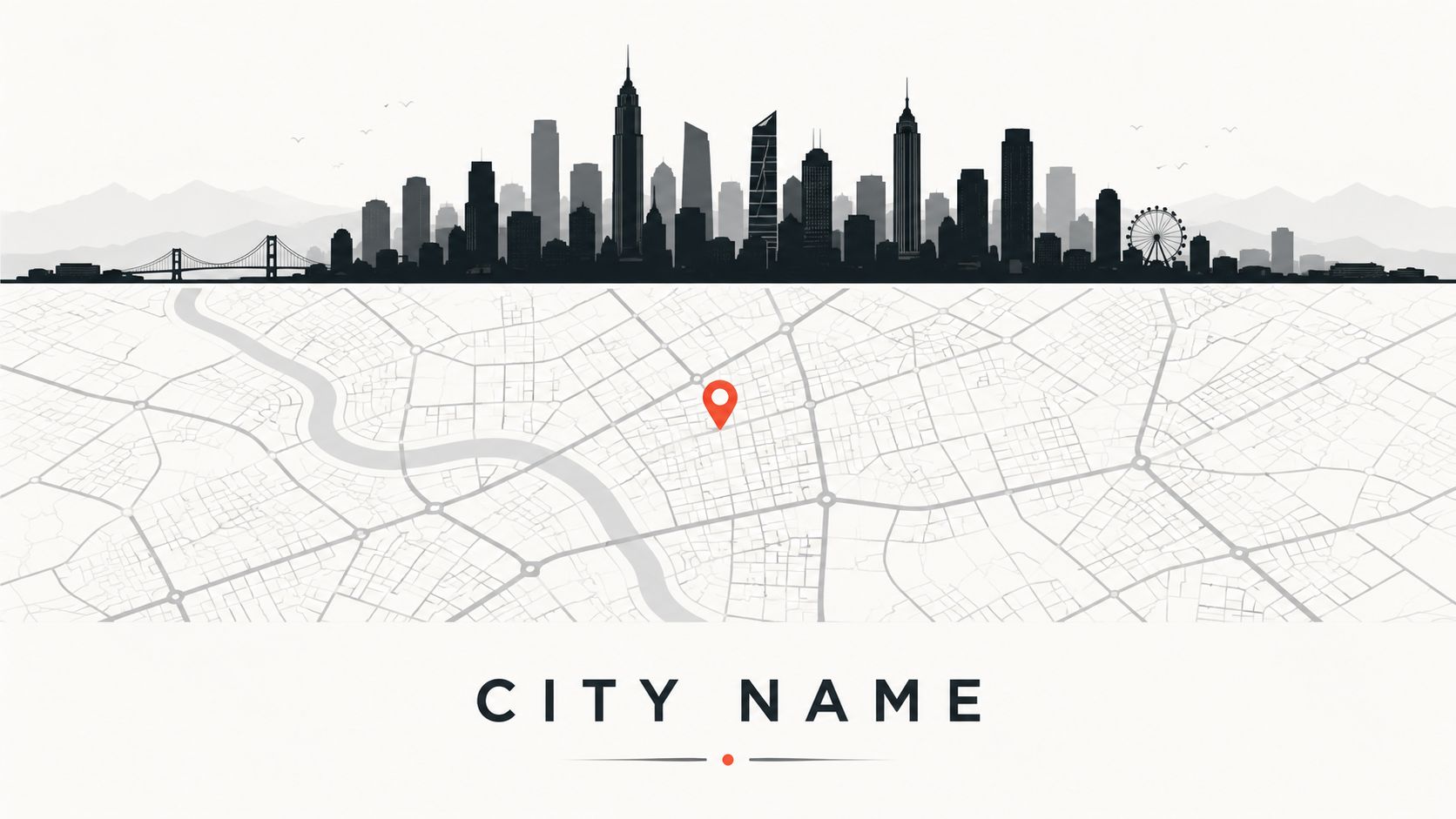
City map and skyline prints work when your story is tied to place more broadly than one relationship milestone. They're ideal for people who've moved often, built a career in a specific city, emigrated from one place to another, or want to mark several meaningful spots within one urban area.
This category also has a practical strength. Map geometry scales beautifully. Streets, river lines, neighborhood blocks, and skyline silhouettes can expand across a large wall without looking blurry or empty. That's important when you need visual weight.
What to highlight and what to leave out
Limit your marked locations. A few intentional points feel meaningful. Too many turn the print into a transit diagram. I usually prefer one home, one work location, one favorite spot, and one defining site such as a proposal location or first apartment.
Good styling moves include:
- Muted tones for modern rooms: Greige, charcoal, sand, olive, and off-black feel architectural.
- Bolder contrast for eclectic rooms: Deep navy, brick, ink, and cream can hold their own against layered interiors.
- Wide frames or float mounting: Both help a large map feel substantial.
Canvas prints hold the largest share of sales in the wall art category at roughly 45% in 2026, while metal prints are identified as the fastest-growing segment, according to wall art statistics summarized by Magnetic Art. For city and skyline pieces, that trade-off is useful. Canvas softens the map. Metal sharpens it. Pick based on the room.
What doesn't work is trying to show an entire life story in one print. If you have multiple cities that matter, a series is usually better.
7. Definition and Word Art Posters
Word art can be outstanding on a large wall if the phrase is personal enough. It fails when the word is generic and the styling tries too hard to compensate. "Home," "love," or "family" only work if the definition sounds like you, not like a gift shop.
I like this format most in entryways, bedrooms, and home offices. Those are spaces where language carries atmosphere. A family definition near the front door can set tone. A single value word in an office can sharpen the room.
Typography decisions that make or break the piece
The best versions rely on hierarchy. One main word. A smaller custom definition. Maybe a line for pronunciation or grammar if that fits the design. After that, stop. Too many typographic tricks weaken the piece.
A few smart ways to personalize it:
- Write your own definition: Use the words your household uses.
- Include names naturally: Fold children, partners, or places into the definition text.
- Choose type styles with restraint: One serif plus one sans-serif is usually enough.
For inspiration on this direction, you can personalize your home with word art.
The stronger the writing, the simpler the layout should be.
This is also one of the more affordable ways to cover a large wall because typography scales well. You don't need elaborate illustration if the language lands.
8. Astrology and Zodiac Sign Personalized Prints
A large zodiac print works when it reads like biography, not novelty decor. The strongest versions use real birth data, a restrained layout, and enough scale to feel intentional from across the room.
Placement matters more here than with many other personalized pieces. Astrology art is usually best in bedrooms, dressing rooms, reading corners, or studios where identity-driven imagery feels natural. In a shared living room, use a cleaner layout and quieter palette so the piece contributes to the room instead of dominating it.
Styling astrology art for a refined look
Start with the level of personalization. If you have the full birth date, time, and city, a natal chart can carry real meaning. If the birth time is unknown, skip the chart wheel and use a sign print, constellation layout, or custom sun-moon-rising trio. In practice, incomplete data is where many astrology prints go wrong. The design looks detailed, but the story is thin.
Scale the piece to the wall, not just the file size. On a bed wall, a single framed chart or paired zodiac set usually needs to land around two-thirds to three-quarters of the headboard width. On a narrow wall section, a vertical 24×36 or 30×40 print often works better than a wide format because the circular chart has room to breathe.
Three directions I recommend often:
- Minimal celestial: Fine line charts, small type, black, ivory, stone, or muted charcoal.
- Vintage astronomy: Star diagrams, aged-paper tones, and classic serif labels for older homes or eclectic rooms.
- Couples pairing: Two charts, two signs, or a shared compatibility print hung as a balanced diptych.
Material choices matter too. Metallic foil, glossy acrylic, and crowded icon sets can push the piece toward novelty fast, especially at large scale. Matte paper, canvas, or a simple frame gives the data room to speak.
If you are combining astrology prints with other personalized pieces, study a few proven approaches to gallery wall layouts and framing. The goal is a wall that feels edited. One chart, one supporting piece, and consistent spacing usually looks better than filling every gap with moons, stars, and symbols.
A final styling note. Match the print to the room's visual language. Modern rooms benefit from clean geometry and low-contrast color. More layered interiors can handle arched motifs, faded gold, or denser celestial linework, but only if the palette still ties back to the textiles, wood tones, and finishes already in the space.
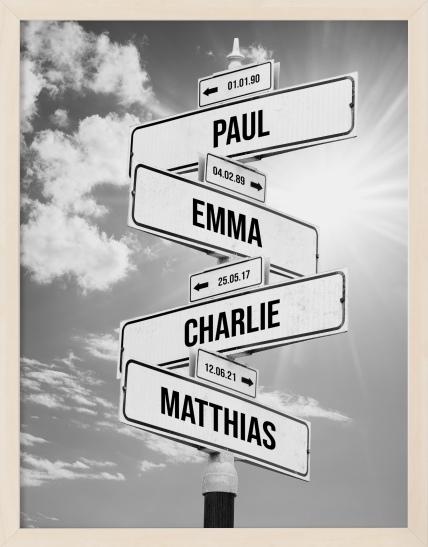
9. Timeline and Milestone Gallery Walls
If one piece can't hold the whole story, build a timeline wall. This is one of my favorite solutions for extra-wide walls because it turns empty space into narrative space. Instead of forcing one oversized print to carry everything, you let several personalized pieces work together.
A relationship wall might include the place you met, the night sky from your engagement, a wedding-day moon phase, then a family portrait later on. A family wall might start with a birth poster, add sibling prints, and finish with a house map from the move that changed everything.
Building a large wall narrative without clutter
Start on paper or on the floor. Layout planning matters more here than with any other item in this list. The easiest mistake is ordering beautiful prints that don't relate in scale, frame depth, or color temperature.
Use these guidelines:
- Keep one unifying element: Same frame finish, same mat style, or one repeating accent color.
- Vary size with purpose: Larger pieces should mark bigger milestones, not random moments.
- Read left to right or top to bottom: Viewers should understand the sequence without explanation.
A quick visual reference can help when you're arranging multiple pieces. This video gives a useful overview of composition and spacing choices for large collections:
For more arrangement ideas, this guide on gallery wall layouts and framing is a practical companion.
A timeline wall should feel edited, not exhaustive. Leave some life events out so the important ones can breathe.
This is one of the most effective wall art ideas for large wall installations because it uses width intelligently instead of just filling it.
10. Large-Format Statement Pieces
Sometimes the right answer is one giant piece. Not a cluster. Not a salon wall. One commanding artwork with enough scale to anchor the room. In 2026, oversized wall art continues to dominate interior expression, and that shift reflects a preference for substantial pieces that create visual clarity instead of scattering attention, as noted earlier in the trend guidance already referenced.
A personalized large-format piece works especially well when the wall sits behind the main furniture grouping. Think over a sofa, above a bed, behind a dining banquette, or at the far end of an open-concept room where the eye naturally lands.
How to make one giant piece feel intentional
The art has to earn the scale. Personal data helps because it gives substance to the size. A giant family portrait, star map, city map, or birth composition can carry a wall because the viewer has something to discover up close.
Essential factors to consider include:
- Reduce surrounding décor: One large piece needs negative space to feel confident.
- Match the orientation to the wall: Wide walls want horizontal movement. Tall walls want a vertical or stacked composition.
- Plan the lighting early: Glare can ruin the effect faster than almost anything else.
What doesn't work is buying a large piece with weak design detail and expecting size alone to save it. Bigger makes problems more obvious. Weak typography, muddy color, or overcrowded layouts get amplified.
If you're choosing just one investment piece for a major wall, this is usually where I'd start. Large-scale personalized art turns that wall into a room-defining feature instead of background.
10 Large-Wall Art Ideas Comparison
Choosing between personalized large-wall pieces gets easier once you compare them by effort, wall impact, and the kind of story they tell. I use a table like this during client planning because a star map, a timeline wall, and a birth poster can all be meaningful, but they ask for very different amounts of wall space, design precision, and installation work.
| Item | Implementation Complexity 🔄 | Resource Requirements ⚡ | Expected Outcomes 📊⭐ | Ideal Use Cases 💡 | Key Advantages ⭐ |
|---|---|---|---|---|---|
| Personalized Star Map Prints | Medium. Needs an exact date, location, and careful star plotting | Moderate. Astronomical data, high-resolution output, and a layout that stays readable at large scale | Strong emotional pull with a clear data-based story | Anniversaries, births, proposals, memorials | Accurate to a specific moment, personal, and easy to size as a single focal piece |
| Custom "Where We Met" Location Maps | Low to Medium. Requires coordinates, map cropping, and clean labeling | Low to Moderate. Map data, typography, and color adjustments | Sentimental wall art with a strong sense of place | Couples, long-distance relationships, wedding gifts | Tells a location-based story quickly and works well in both modern and traditional rooms |
| Moon Phase Calendar Posters | Low. Date input and lunar layout are straightforward | Low. Date data and graphic templates | Quiet, personal artwork with light calendar function | Pregnancy timelines, anniversaries, wellness tracking | Strong vertical formatting options and a clean visual rhythm for narrow walls |
| Custom Family Portrait Illustrations | High. Styling choices, revisions, and photo quality all matter | High. Artist time, reference images, and proofing rounds | Warm, character-driven focal art that feels more individual than a standard photo enlargement | Family rooms, new parents, gifts for blended families | Captures personality, simplifies busy photos, and can unify different family members in one palette |
| Personalized Birth Announcement Posters | Low. Works from a fixed set of birth details and typography | Low. Print production and design template assets | Keepsake art that documents a life event clearly | New parents, hospital gifts, nursery displays | Easy to personalize, easy to frame, and strong for grid layouts or a single nursery statement piece |
| Custom City Map and Skyline Prints | Medium. Needs accurate cartography and balanced composition | Moderate. Map files, skyline vectors, and design variations | Place-based identity with clear focal-wall potential | Relocations, hometown pride, travel memory displays | Combines map detail with recognizable architecture, which gives viewers more to study up close |
| Definition and Word Art Posters | Low. Mostly typographic layout and spacing decisions | Low. Fonts, templates, and color selection | Personal text-based statement with clean visual impact | Home offices, entryways, gifts built around family values or inside jokes | Flexible, easy to scale, and especially effective in minimalist rooms that need meaning without visual clutter |
| Astrology and Zodiac Sign Personalized Prints | Medium. Simple zodiac pieces are easy. Full birth charts require more precision | Moderate. Astrological calculations and design options | Identity-focused art with strong appeal for a specific audience | Astrology enthusiasts, bedrooms, personal corners | Personal symbolism, layered visual detail, and good potential for paired or triptych layouts |
| Timeline and Milestone Gallery Walls | High. Multiple pieces must relate in size, spacing, and story order | High. Several prints, matched frames, and careful installation | Rich narrative effect with strong visual presence across a wide wall | Families, long-term couples, multi-stage milestone displays | Connects several personal moments in one system and fills a large wall without relying on one oversized print |
| Large-Format Statement Pieces | High. Scaling, production, delivery, and hanging all require planning | Very High. Oversized printing, framing or canvas mounting, and logistics | Dramatic room-defining impact when the artwork has enough detail to hold the scale | Feature walls, high-budget interiors, commercial displays | Maximum presence, fewer pieces to coordinate, and strong results when the personalization is built for close viewing |
The practical decision usually comes down to two questions. Do you want one data-rich piece that anchors the room, or a multi-piece arrangement that rewards closer viewing over time?
If the wall is wide and uninterrupted, timeline walls, city prints, and large statement pieces usually make better use of the span. If the wall is tall or narrower than expected, moon phase posters, birth prints, and vertical star maps tend to fit with less wasted space. That sizing match matters as much as the design itself. A meaningful print that is badly proportioned will still look underplanned.
For clients who want the strongest balance of story, scale, and install simplicity, I usually start with star maps, location maps, or city-based prints. They carry personal data well, read clearly from across the room, and still hold attention up close.
From Blank Space to Personal Statement
A client usually reaches this stage after living with a big empty wall for months. The sofa is in place, the lighting works, and the room still feels unfinished because the wall says nothing about the people in it. Large-scale personalized art fixes that problem by giving the wall a clear subject, not just more decoration.
On a wide surface, generic prints often read as placeholders. Personalized work holds up better because it carries identifiable information: a date, a set of coordinates, a skyline tied to a real city, a birth record, a family likeness, or a visual timeline. That story is what gives the piece staying power after the novelty wears off.
Start by choosing the type of information you want to live with every day. For a quieter, more reflective room, star maps and moon phase pieces tend to work well. For homes shaped by place, location maps and city prints usually feel stronger. For family-centered spaces, portraits, birth posters, and milestone timelines bring more emotional weight.
Then make the wall plan match the architecture. Measure the furniture first and use that width to set the artwork span. Keep the composition visually connected to the piece below it, and hang it low enough to relate to the seating, console, or bed rather than drifting upward. I also keep surrounding decor restrained. A personalized wall piece already carries detail, so extra styling should support it, not compete with it.
In this category, customization deserves close attention. Exact dates, correct coordinates, accurate spelling, clean photo files, and consistent framing choices make the difference between a polished installation and one that feels improvised. If you're ordering online, choose a brand that gives you control over those inputs. Revellia is one option in this space, offering personalized posters and prints such as maps, celestial charts, moon phases, and illustrated family portraits.
The strongest large-wall ideas do more than fill square footage. They document something real, at a scale the room can support.
For more inspiration on customized pieces that still work within a real decorating budget, browse these ideas for affordable home wall decor.
If you're ready to turn one meaningful date, place, or family memory into a large-scale focal point, explore Revellia. Its editor lets you customize posters and prints such as star maps, location maps, moon phases, birth posters, and family portraits, so you can build wall art that fits both your story and your space.