You're probably here because a normal gift feels too flat.
A photo is lovely, but it shows what people looked like. Jewelry can be meaningful, but it often needs the right taste, size, or budget. A custom star map print does something different. It turns a date, a place, and a feeling into a visual record of the sky above that exact moment. That's why people choose it for weddings, births, anniversaries, and quiet personal milestones that don't fit inside a standard gift box.
What makes it special isn't just the look. It's the idea that the sky on the print was real. Not a decorative scatter of stars, but a reconstruction of what was overhead when something important happened.
Table of Contents
- What Is a Custom Star Map Print?
- How It Works From Data to Decor
- Designing Your Personal Cosmos
- The Perfect Gift for Any Milestone
- The Revellia Difference in Quality and Sustainability
- Your Custom Star Map Questions Answered
What Is a Custom Star Map Print?
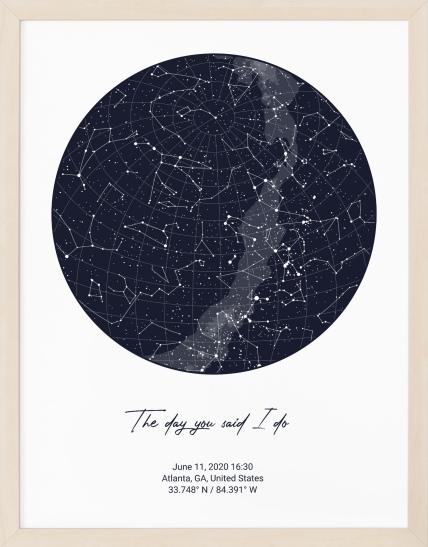
A custom star map print is a personalized chart of the night sky for a specific date, time, and place. Think of it as a time capsule you can frame.
Someone might choose the sky above a wedding venue. Another person might mark the hour their child was born. A couple might recreate the stars from the night they first met. In each case, the print connects a memory to a real point in the sky.
That's the first place people get confused. They assume it's star-themed wall art. It isn't, at least not when it's made properly. Generic celestial posters use an attractive night-sky style. A star map uses astronomical data to recreate one moment.
A good star map feels romantic because it's specific. It says, “This was the sky above us then.”
That specificity is what gives the print emotional weight. If you hang a map for “our first apartment” or “the night you were born,” the design carries a story before anyone reads the caption.
It's also useful to view it as a fingerprint. Lots of skies look similar at first glance, just as lots of fingerprints look like loops and swirls. But the exact combination of time and place makes the final pattern yours.
People often buy these prints for two reasons at once. They want something beautiful on the wall, and they want something that points back to a real memory. A custom star map print works because it does both.
How It Works From Data to Decor
The easiest way to understand the process is to picture a mapmaker working with the sky instead of streets. The mapmaker needs three coordinates for the memory: date, location, and time.
A sky tied to one exact moment
The date tells the system which night to rebuild. The location tells it where on Earth the viewer stood. The time matters because the sky keeps moving. According to Stars in Hands, leaving out the exact time can shift positions by several degrees because stars move about 15 arcminutes per minute of time.
That sounds technical, but the idea is simple. If date and location are the address, time is the room number.
Here's how each input changes the result:
- Date: Changes which stars and planets were in seasonal view.
- Location: Changes the angle of the sky because someone in Paris doesn't see the same sky as someone in Sydney.
- Time: Changes the exact arrangement because the Earth is rotating the whole time.
Practical rule: If you know the exact time, use it. If you don't, choose the closest meaningful time and treat the print as a commemorative piece rather than a minute-perfect reconstruction.
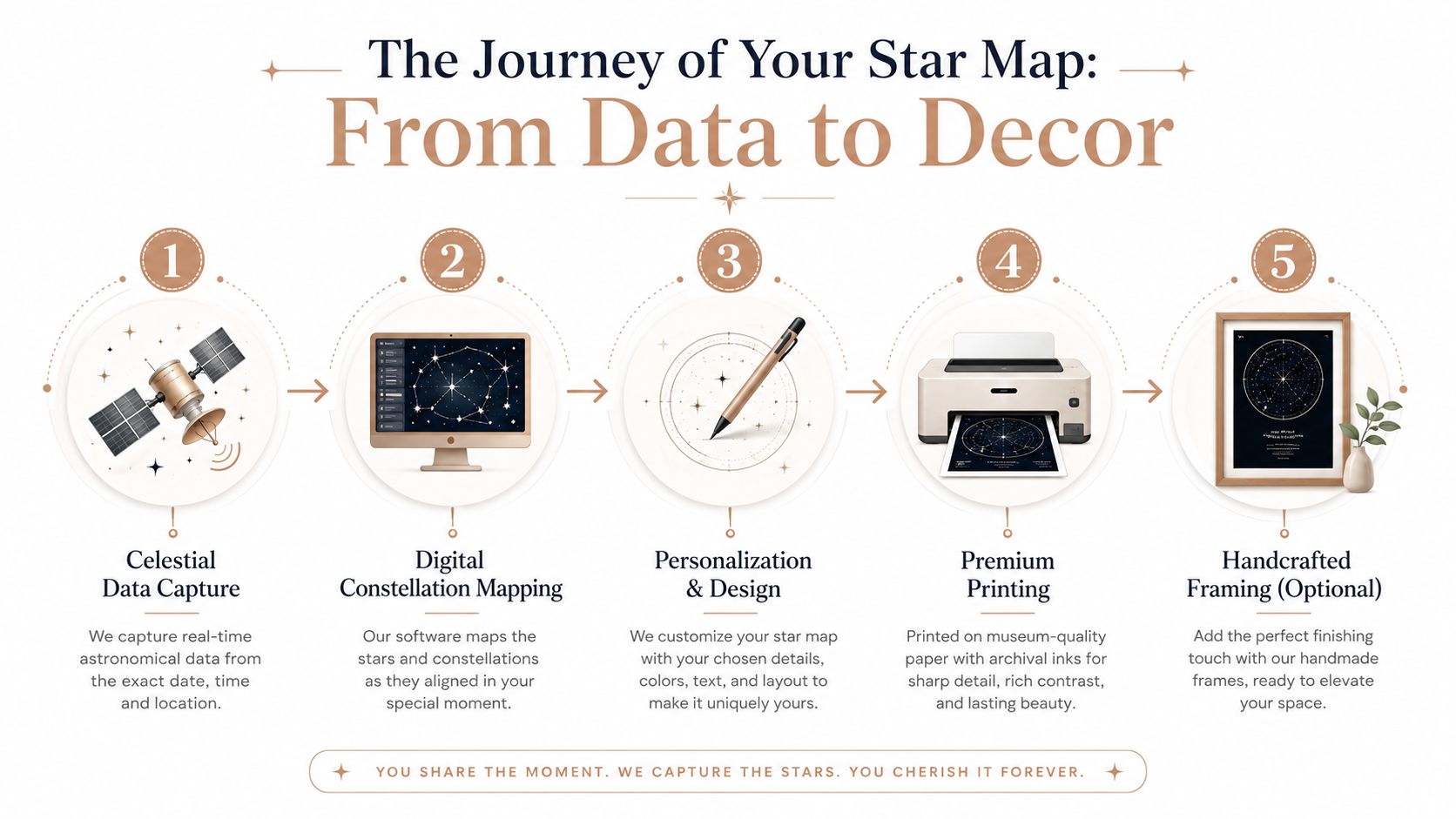
Professional services don't draw these maps by hand. They use astronomical algorithms to calculate where celestial objects appeared from a chosen viewpoint.
What professional map engines actually calculate
The finished print may look calm and minimal, but the engine behind it is doing dense work. As described in Skylit Studio's buyer's guide to personalizing a custom star map, professional-grade generators calculate the apparent positions of major stars, constellation lines and labels, plus the positions of the Sun, Moon, and visible planets relative to the observer's horizon. They do this using astronomical algorithms, star catalogs such as Hipparcos or Gaia, and planetary ephemerides.
In plain language, that means the system asks: What would a person standing there, at that time, have seen?
Reputable providers also render a lot of detail. The custom star map market includes services that visualize between 7,000 and 8,000+ stars, often with moon phases, planet positions, and constellation lines, according to this overview of personalized star map accuracy. That same source notes that astronomical algorithms can reconstruct skies for dates from 1900 to 2050 for any global coordinates the user enters.
If you're comparing tools, one example is a Personalized star map that recreates the night sky for a special moment. That description matters because it points to the core function of the product, not just the decorative style.
A helpful analogy is sheet music. Two printed scores may both look elegant on paper, but only one may be the correct version of the song. A strong star map generator works the same way. The design is the presentation. The astronomy is the score underneath it.
Designing Your Personal Cosmos
Once the sky is accurate, the design choices decide how the memory feels on the wall. At this point, the print stops being a chart and starts becoming part of a room.
Start with the story, then choose the style
A lot of people begin with color. I'd start with the event instead.
A wedding map can handle a formal layout, restrained typography, and a dark sky background. A birth print often feels softer with light neutrals or muted tones. A graduation or travel memory can carry a cleaner, more graphic style.
That approach helps you avoid a common mistake. People sometimes add every available detail because they want the print to feel meaningful. Usually, the opposite works better. One clear title, one date, one place, and a calm layout often create a stronger emotional effect than a crowded design.
This kind of editor view helps people make those decisions visually:
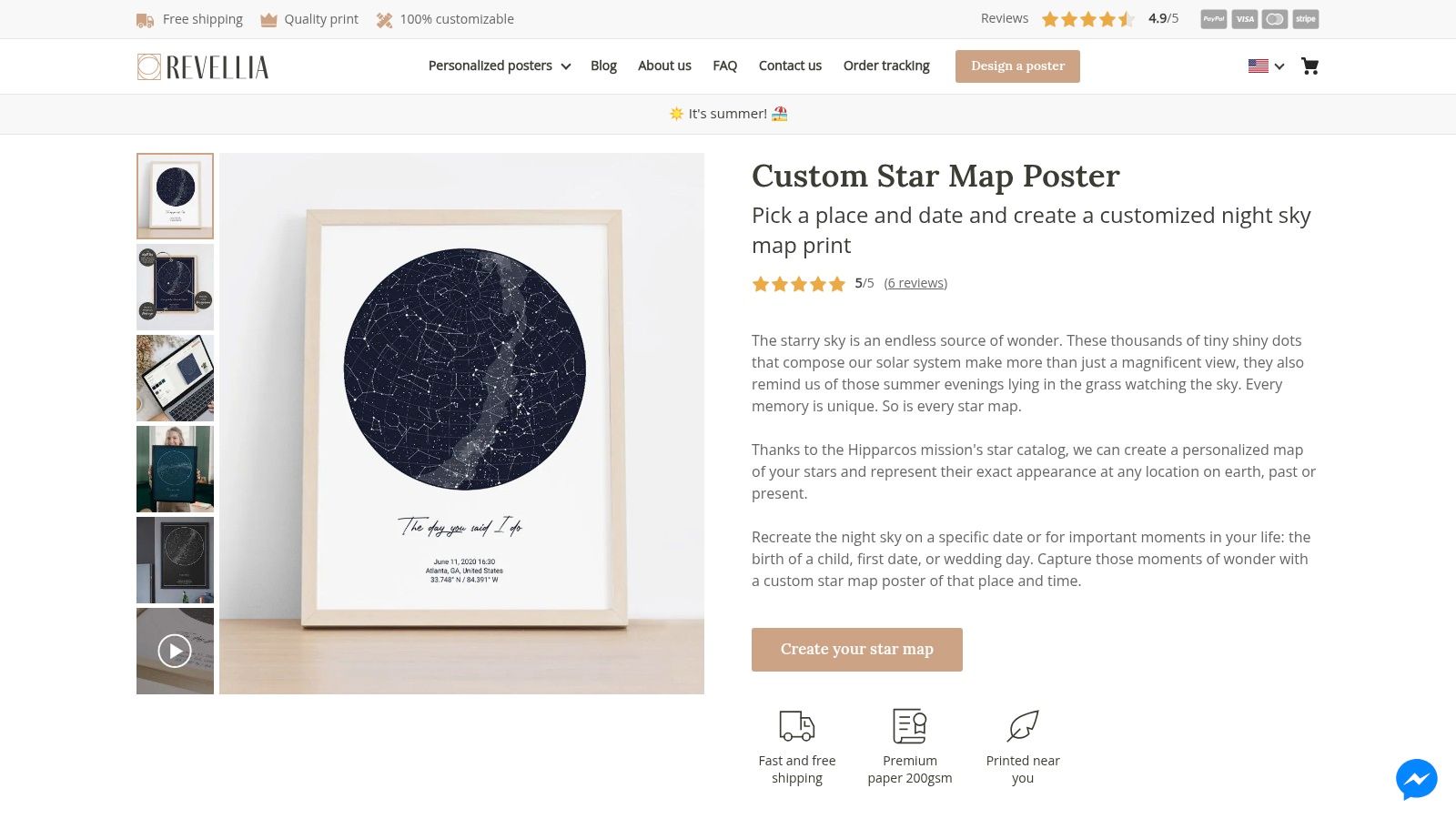
A useful design checklist looks like this:
- Choose the mood first: Minimal, romantic, modern, or more scientific.
- Decide how much sky detail you want: Some people like constellation labels and planetary detail. Others want a cleaner field of stars.
- Keep text short: Names, date, location, and one line of meaning usually carry enough emotion.
- Match the room: Black, cream, navy, and soft gray are easier to live with than novelty color palettes.
If you enjoy the astronomy side of the design, it can be fun to study a specific constellation before you finalize the print. For example, this guide to the essential stars in constellation Lyra gives useful context if Lyra appears prominently in your chosen sky.
The best star map designs don't shout. They let the date and the story do the work.
How format changes the final feel
Format affects both budget and presence. According to Starry Memory's custom star map comparison, custom star map prints range from €3.99 for digital-only HD files to over $250 for large, framed physical posters. The same source says the most common 12×16 inch unframed prints typically cost $39 to $130, depending on the vendor and paper quality.
That wide spread makes sense because buyers aren't all purchasing the same thing. Some want a fast digital file for local printing. Others want a ready-to-hang piece made with premium materials.
A simple comparison helps:
| Format | Best for | What it feels like |
|---|---|---|
| Digital file | Last-minute gifting, DIY framing, local print shops | Flexible and fast |
| Unframed print | People who want frame freedom | Clean, adaptable |
| Framed print | Ready-to-gift occasions | Finished and polished |
If paper quality is offered, matte stock usually suits star maps well because it keeps the design soft and gallery-like. Framing adds visual weight, but it also changes the tone. A thin black frame feels architectural. Light wood feels warmer and more domestic.
The design choice should fit the memory. A baby's birth map doesn't need to look like a museum placard. A wedding print might benefit from that sense of formality.
The Perfect Gift for Any Milestone
Some gifts say, “I bought you something.” A star map says, “I remembered exactly when this mattered.”
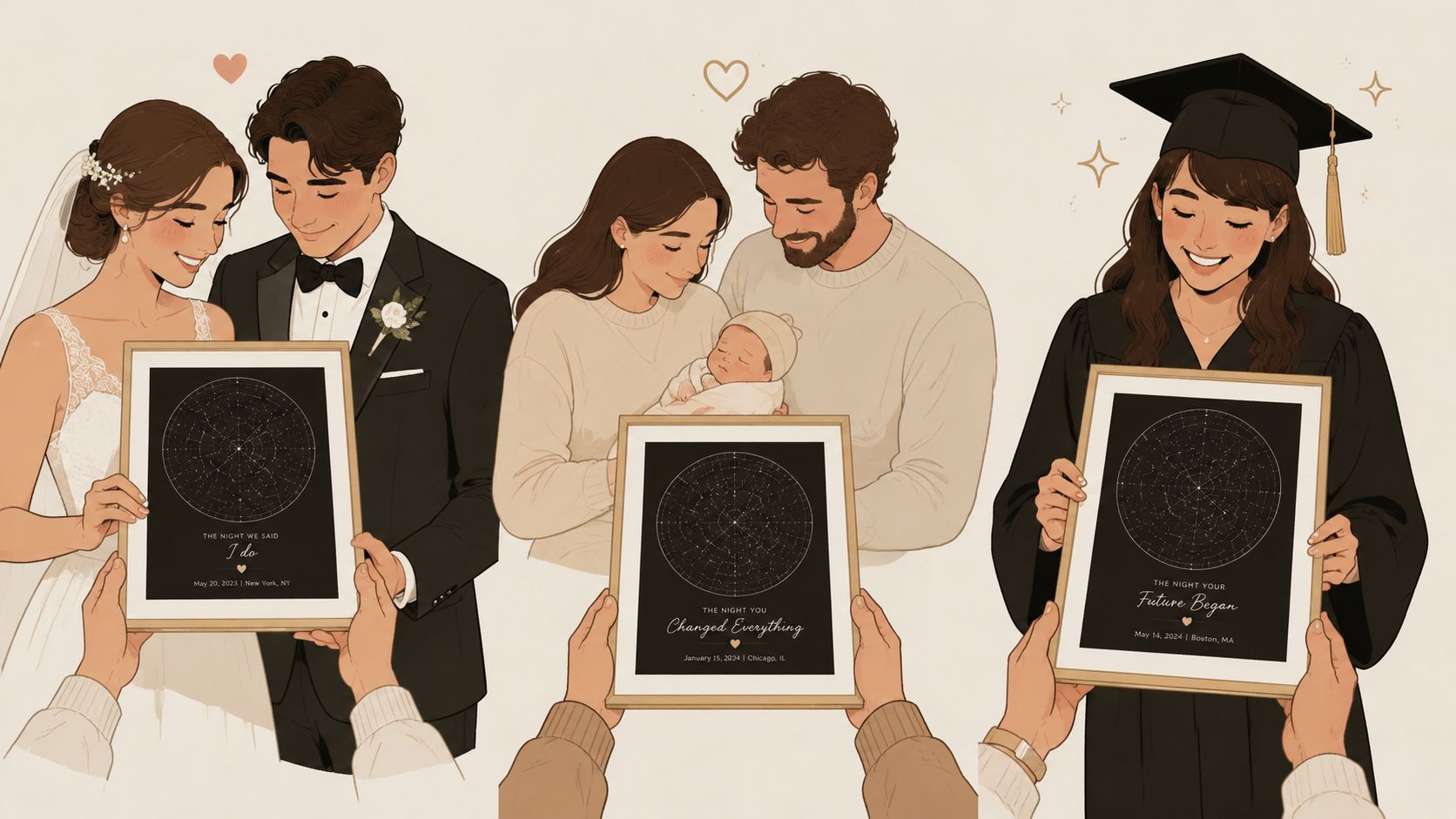
Moments that work especially well
For couples, the obvious choices are strong for a reason. The night you met. The proposal. The wedding date. Those moments already have a built-in story arc, and the print gives that story a physical form.
For new parents, a birth map has a different emotional tone. It isn't about romance. It's about arrival. The print becomes a way to say, “This is the sky that welcomed you.”
Graduations, first homes, big moves, and personal turning points also work well. These prints often feel more reflective than sentimental. They're less about giving a gift to someone else and more about marking a chapter in your own life.
Here are a few message ideas that tend to work:
- For weddings: “Under This Sky, We Said ‘I Do’”
- For births: “The Night You Joined Our World”
- For anniversaries: “Where Our Story Began”
- For graduations: “The Start of a New Chapter”
People who are thinking about partner gifting more broadly may also enjoy Ecuadane's perspective on custom gifts for partners, especially the way personalization strengthens the emotional message of a gift.
How to make the message feel personal
The wording matters almost as much as the sky. A generic line can flatten a beautiful print. A specific line can make it unforgettable.
Use language the recipient would recognize from your life together. Maybe that's the venue name. Maybe it's a family phrase. Maybe it's just a date and city because the restraint feels more honest.
Here's a short video that shows how people use star maps to mark milestone moments in a way that feels both decorative and personal.
A good test is this: if you removed the stars and kept only the text, would the wording still mean something to the person receiving it? If yes, the print will probably land well.
The Revellia Difference in Quality and Sustainability
A custom star map print asks people to trust two things at once. They need to trust the memory, and they need to trust the object. If the print feels flimsy or the production model feels careless, some of the meaning gets lost.
Why local printing matters
Shipping is one of the least discussed parts of personalized wall art, even though it affects both delivery experience and environmental impact. A growing concern around custom star maps is how far they travel before they reach the buyer.
According to this market note on custom star map shipping and sustainability, Revellia saves an average of 3,445 km per order through localized on-demand printing, and 68% of global shoppers prefer brands that reduce shipping emissions. That's an important distinction because “personalized” doesn't automatically mean low-waste or low-transport.
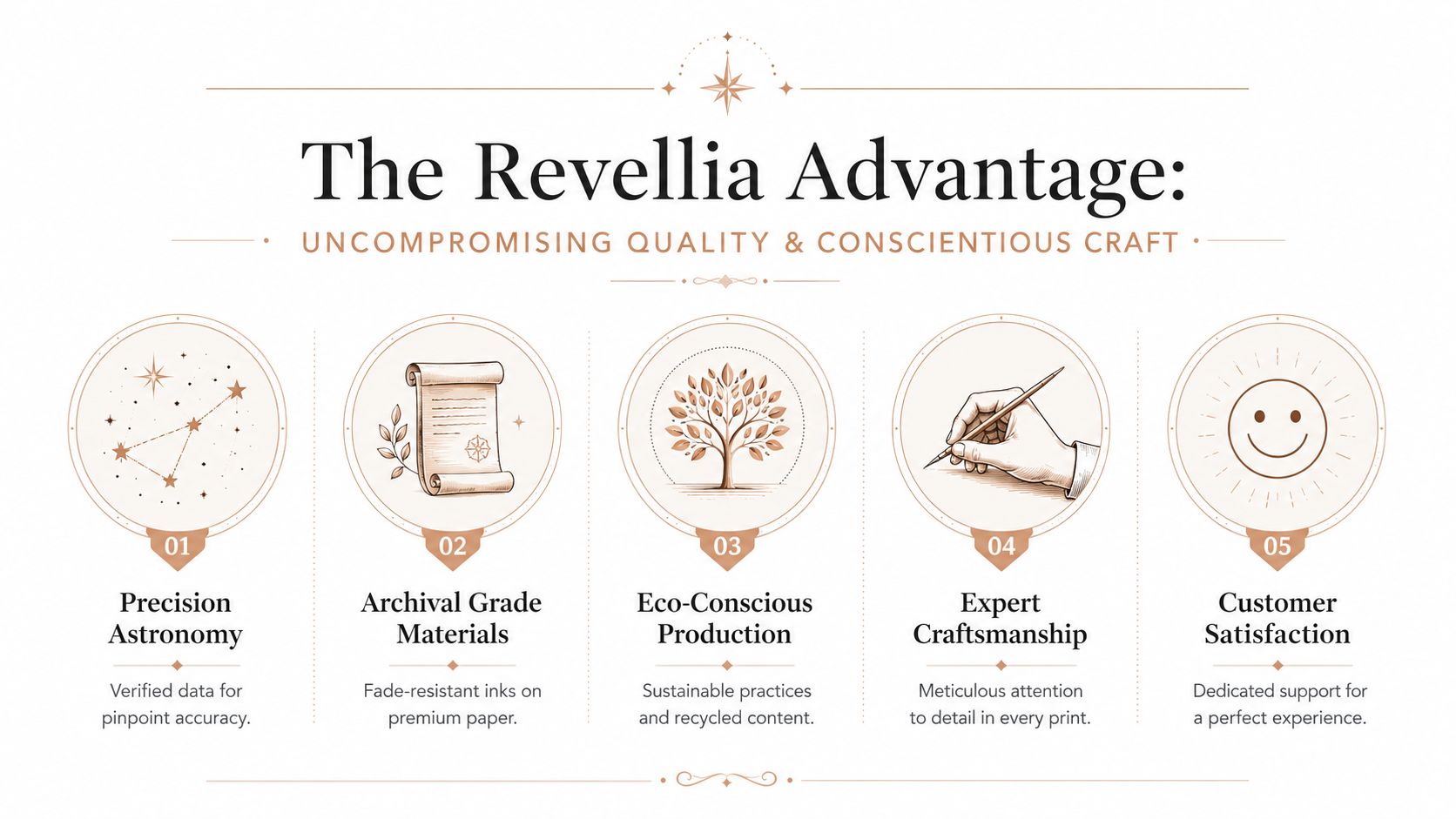
Local production changes more than distance. It often makes gifting simpler because the print doesn't have to cross as many borders or logistics handoffs.
What to look for in the finished print
Materials matter with a design this minimal. A star map doesn't hide much. If the paper looks cheap or the ink feels harsh, the whole piece can lose its calm, archival character.
When comparing providers, I'd look for these practical signals:
- Paper quality: Museum-quality matte paper tends to suit this kind of print.
- Responsible sourcing: FSC-certified materials are worth checking for.
- Print-on-demand production: This usually avoids excess stock and unnecessary waste.
- Clear design preview: A live editor helps you catch awkward spacing and line breaks before ordering.
The point isn't to turn a sentimental purchase into an audit. It's to make sure the physical object respects the meaning you're attaching to it.
Your Custom Star Map Questions Answered
What if I don't know the exact time?
Use the most meaningful reliable time you have. If it was a wedding, that might be the ceremony start. If it was a birth, use the birth time if you know it. If the exact minute is unknown, choose a date and location confidently, then treat the map as a memory piece rather than a precision timestamp.
Are free DIY star map tools as accurate as commercial ones?
Sometimes they're fine for casual use, but accuracy varies. As discussed in this Reddit thread on printing a sky map, amateur tools often omit planets or use outdated star catalogs, while professional vendors such as The Night Sky explicitly use the European Space Agency's Hipparcos satellite catalogue to map every visible star and planet.
How can I tell whether a star map is based on real data?
Check what the provider says about its data source and generation method. Look for mentions of star catalogs, planetary calculations, or astronomical databases. Be cautious if the product page talks only about style, romance, or wall decor and says nothing about how the sky is generated.
If the seller explains the data, the map is easier to trust. If the seller explains only the frame color, ask more questions.
Should I choose digital or printed?
Pick digital if time is tight or you want to print locally. Pick a physical print if presentation matters and you want the piece to arrive ready for gifting or framing. The better option depends on whether speed or finish matters more for your occasion.
If you want to turn a date, place, and memory into something you can hang on the wall, Revellia offers personalized posters and prints through an in-browser editor, including star maps designed around a specific moment.