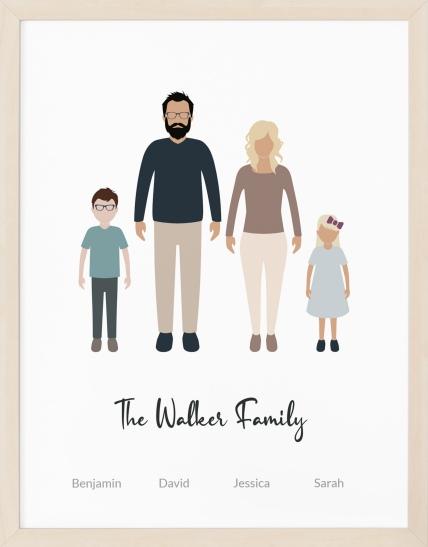
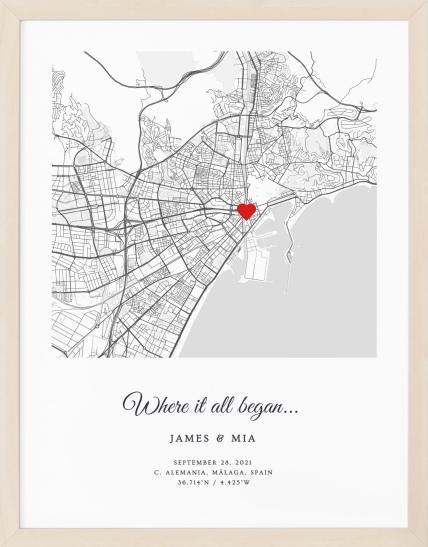
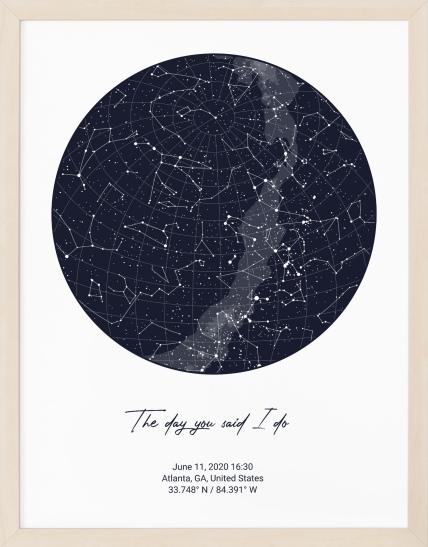
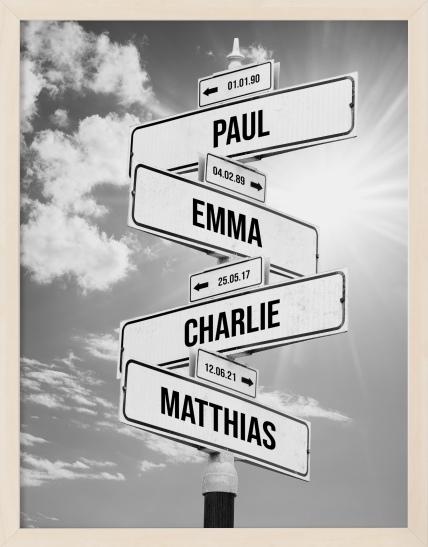
You're probably here because a standard gift feels too thin for the moment you're trying to mark. A birthday can take flowers. An anniversary can take a dinner reservation. But some dates ask for something that feels anchored, something that says this happened under a real sky, at a real place, at a real time.
That's why a custom moon phase print lands so differently. It can be romantic, quiet, and decorative all at once. But after making and comparing these prints, one thing stands out fast: the design matters, and the astronomical accuracy matters just as much. If the moon on the print doesn't match the moment it claims to represent, the piece turns into generic celestial art instead of a personal record.
Table of Contents
- Why a Custom Moon Phase Print Is So Meaningful
- Capturing Your Moment in Time and Space
- Designing a Print That Reflects Your Style
- Choosing the Perfect Physical Format and Finish
- Gifting, Framing, and Displaying Your Moon Print
- Common Questions About Custom Moon Prints
Why a Custom Moon Phase Print Is So Meaningful
A custom moon phase print works because it captures a moment without being literal. It doesn't rely on a posed photograph or a long written message. Instead, it marks a date through the sky itself, which gives the piece emotional weight without making it feel overly sentimental.
That's especially powerful for milestones that people revisit again and again. A wedding date, a child's birth, the day two people met, the night of a proposal. The moon turns that event into a visual artifact. Hung in a bedroom, hallway, or living room, it keeps the memory present without shouting for attention.
There's also a useful distinction to make here. Some prints are decorative moon art. Others are meant to represent a real celestial condition from a specific date and place. If you want the second kind, accuracy isn't a bonus feature. It's the whole point.
Accuracy changes the meaning
Many sellers use language like “astronomical calculations,” but that phrase can hide a lot of variation. Different tools can interpret time zones, longitudes, and date boundaries differently. For non-UTC dates, those differences can lead to deviations of up to 1 to 2 degrees in moon position, which matters if you care about fidelity to the actual sky.
That nuance is one reason buyers have become more careful. A 2025 trend analysis cited by Positive Prints' article on personalized moon phase prints notes a 45% increase in search queries for “moon phase print accuracy” in major markets like the US and UK. People still want sentiment, but they also want to know the print reflects the date accurately.
A moon print feels more intimate when you know it wasn't pulled from a generic lunar graphic.
In practice, that means the most meaningful custom moon phase print is the one that balances two jobs well. It should look beautiful on the wall, and it should hold up when someone asks, “Was that really the moon that night?” If a print can't answer that second question confidently, its emotional value gets thinner.
Capturing Your Moment in Time and Space
The strongest moon prints start with careful input. Before fonts, colors, or framing, the core job is entering the event details correctly. A moon phase image isn't just tied to a date. It's shaped by date, time, and location together.
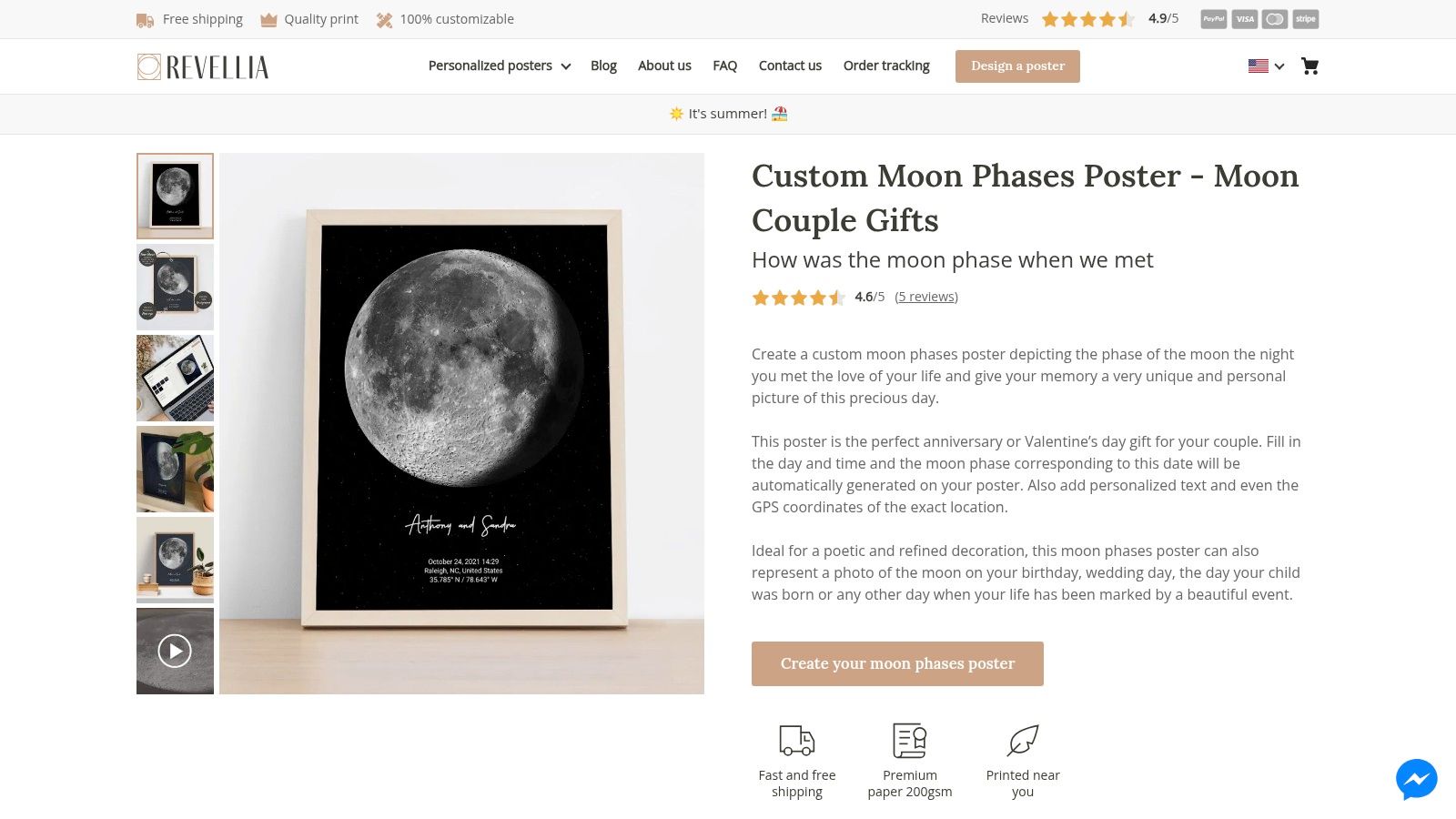
Here's what that looks like in an editor.
The three details that shape the result
Start with the date. This seems obvious, but it's where people make the first avoidable mistake. Double-check whether the meaningful moment happened just before or after midnight, especially for births, travel-heavy proposals, or ceremonies that stretched late into the evening. A one-day shift can change the phase enough to affect the whole print.
Then enter the time as precisely as you can. If you know the exact birth time or ceremony start time, use it. If the event was less exact, choose the closest honest estimate and stay consistent with the story you're commemorating. For example, if you're marking the moment you got engaged, use the time it happened, not the time the dinner reservation began.
Location matters because the moon isn't experienced from nowhere. Add the city or specific place tied to the event, not where you live now or where the gift recipient currently lives. If the memory is “the night we met in Lisbon,” use Lisbon. If it's “our daughter was born in Chicago,” use the hospital city.
One example of this workflow is the Personalized moon phases poster, described as a moon phase poster for a memorable date. In an in-browser editor, the practical advantage is seeing the visual update while you adjust the date, text, and styling.
What to do if you don't know the exact time
This is common, especially for anniversaries and older family events. Don't abandon the idea just because you can't verify the minute.
A simple way to handle it is:
- Use a documented time first: Birth certificates, calendars, messages, and travel confirmations are often enough.
- Anchor to the actual event: If the exact minute is unknown, choose a reasonable time connected to the story, such as evening for a proposal or midday for a ceremony.
- Avoid false precision: Don't invent a hyper-specific time just because the form allows it.
Practical rule: A good estimate tied to the real event is better than a made-up exact time that feels official but isn't.
I've found that people often overfocus on getting every design detail perfect while rushing through the data fields. That's backwards. If the date, time, and location are wrong, no font pairing can rescue the meaning.
Designing a Print That Reflects Your Style
Once the moon data is set, the creative decisions become much easier. At this stage, the goal isn't to add more. It's to build a design where the moon remains the hero and everything else supports it.
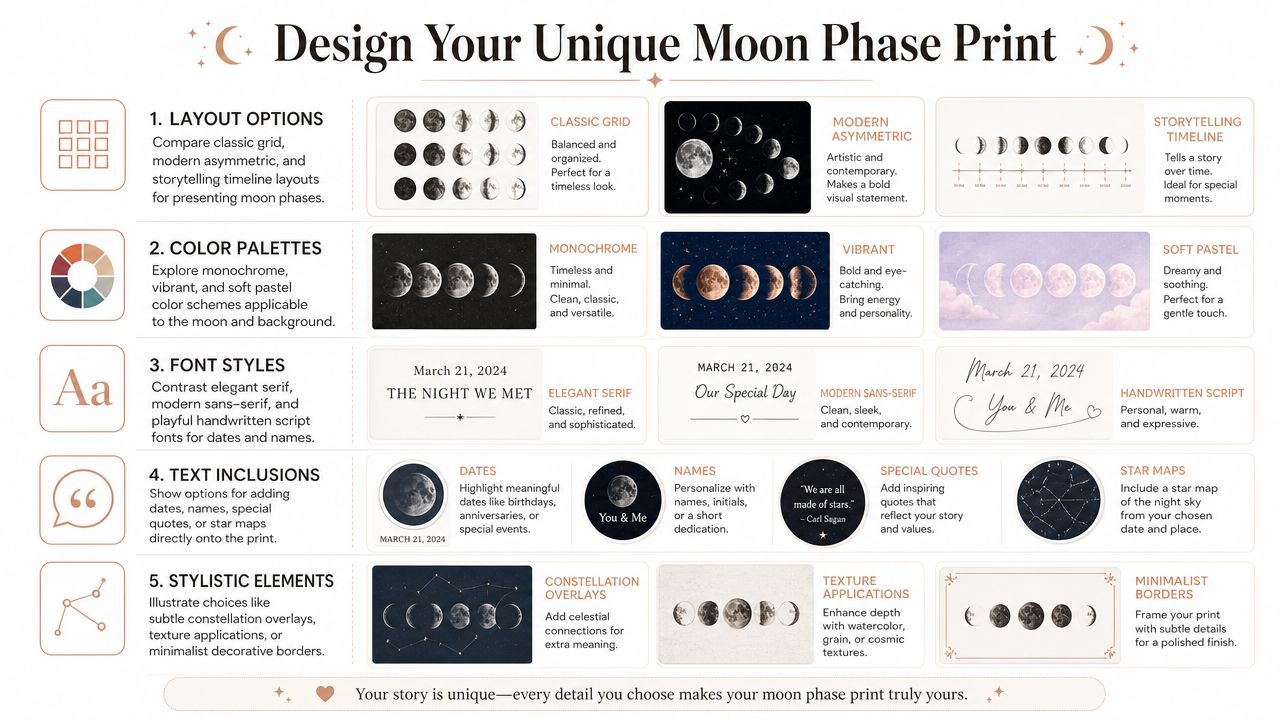
This visual guide is useful for comparing the main design directions at a glance.
Choose a layout that matches the story
A single-moon layout is often the strongest choice for one event. It feels clean, centered, and timeless. This format suits births, wedding dates, memorial pieces, and milestone anniversaries because the whole design revolves around one exact night.
A paired format works better when the story is about two people rather than one date. If you're comparing two birthdays or two meaningful dates, a compatibility-style composition can make sense. It turns the print from a snapshot into a relationship piece.
A timeline layout is useful when the emotional point is progression. That can work for a baby's first months, a relationship arc, or a set of family milestones. It's less quiet than a single-moon print, but it can feel rich and narrative when done with restraint.
Here's a quick way to decide:
| Layout style | Best for | Watch out for |
|---|---|---|
| Single moon | One unforgettable date | Overfilling empty space with extra text |
| Paired moons | Couples and shared stories | Making both sides compete visually |
| Timeline layout | Multi-date storytelling | Turning the design into a scrapbook |
Build a palette that works in a real room
Many people choose colors based on emotion first, then regret how the print sits in their home. Start with the room.
If the print will hang in a calm bedroom, soft neutrals, charcoal, cream, muted navy, and warm gray usually age well. In a modern living room, black and off-white often look sharper than heavily saturated cosmic blues. For a nursery, dusty sage, pale beige, and gentle blush tones can keep the artwork sweet without feeling theme-heavy.
You can also assign symbolism to color, but keep it subtle:
- Deep blue tones: good for a night-sky mood
- Warm beige or sand: easy to mix with wood frames and soft interiors
- Black and white: best for a graphic, contemporary look
- Soft pastels: useful when the print is meant to feel tender rather than dramatic
If your wall already has texture, color, or nearby artwork, the moon print should calm the space, not compete with it.
Use text like a design element
The text should support the memory, not explain it to death. The best moon prints usually include just enough wording to orient the viewer.
That might be:
- Names: first names often look better than full formal names
- A date: especially if the print marks a wedding, birth, or engagement
- A short line: a place name, a simple phrase, or a brief dedication
Long quotes are where many otherwise elegant designs start to wobble. If the text block becomes visually heavier than the moon graphic, the piece loses balance.
A few combinations that tend to work well:
- Minimalist: names + date
- Romantic: names + date + short phrase
- Location-led: place name + date + coordinates-style wording if you like a geographic feel
- Nursery style: baby's name + birth date
Font choice matters more than people expect. Serif fonts usually feel ceremonial and classic. Sans-serif fonts feel modern and clean. Handwritten scripts can work for romantic gifts, but only when used sparingly. A script font for the entire print often reduces readability.
Keep one font expressive and the other quiet. If both are decorative, the print starts to feel busy.
When I make these prints, I usually trim the text twice. The first draft says everything. The final draft says only what the eye needs.
Choosing the Perfect Physical Format and Finish
A strong digital design can still fall flat if the physical print doesn't suit the space. Paper finish, scale, and framing style all change how the artwork reads once it's on a wall or shelf.
Paper finish changes how the artwork feels
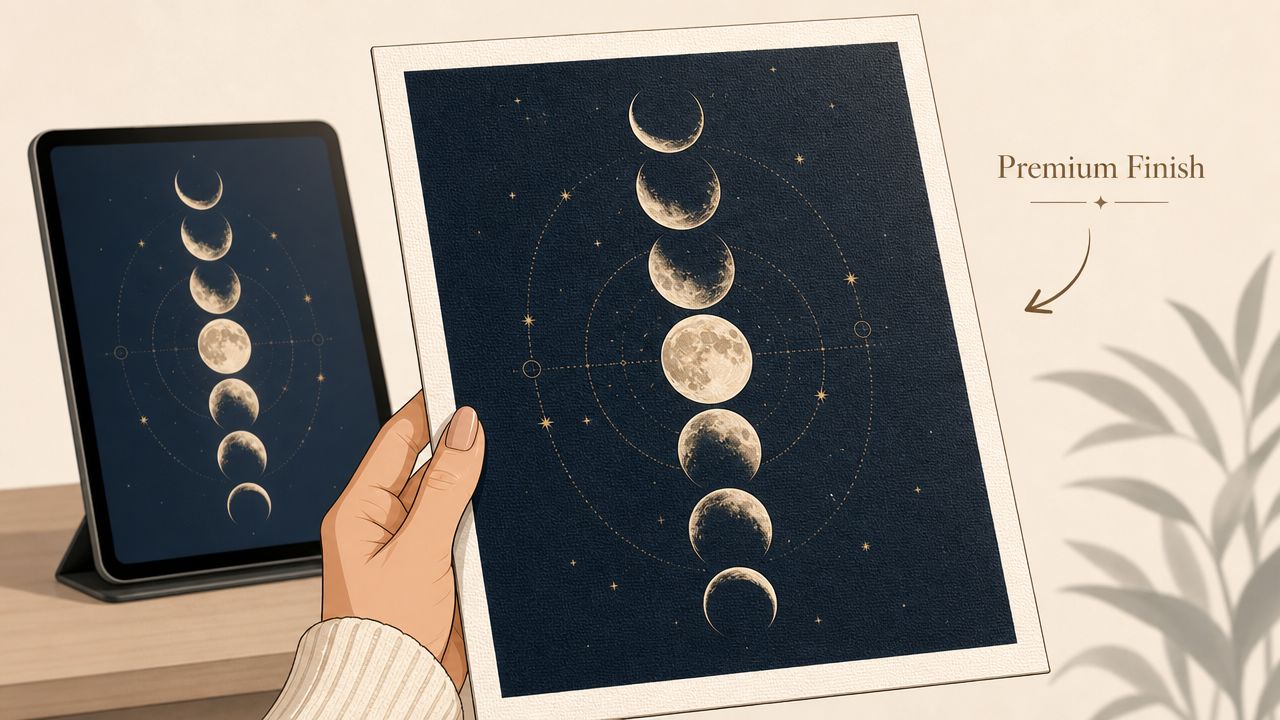
For celestial artwork, museum-quality matte paper makes practical sense. It reduces glare, which helps when the print includes dark backgrounds, subtle lunar shading, or fine text. A glossy finish can reflect windows and lamps so strongly that the moon image becomes harder to appreciate from an angle.
Matte paper also tends to feel calmer and more elegant in home settings. That's especially helpful if the design is minimalist. The paper lets the contrast and composition do the work instead of adding shine as a visual effect.
Material quality matters even more if the print is meant to be kept for years. Archival-minded paper and careful printing give the piece a keepsake quality rather than a poster-shop feel.
Match the print size to the wall
Choosing the right size is mostly about viewing distance and surrounding furniture.
- Small format: ideal for a bedside table, dresser, or narrow shelf where the print will be seen up close.
- Medium format: a strong fit for gallery walls, entryways, and home offices where you want presence without dominance.
- Large format: works above a sofa, bed, or console when the moon print is the main focal point.
If you're ordering unframed art, it helps to think about border space and frame depth before checkout. This guide to unframed art prints is useful for understanding how paper prints behave once they leave the screen and enter a real room.
I usually advise people to size up if they're torn between two options and the wall is mostly blank. Moon artwork often looks more intentional when it has enough space to breathe.
Gifting, Framing, and Displaying Your Moon Print
Some gifts are appreciated in the moment. A moon print tends to become part of a home. That makes it especially good for milestones that people want to revisit visually over time.
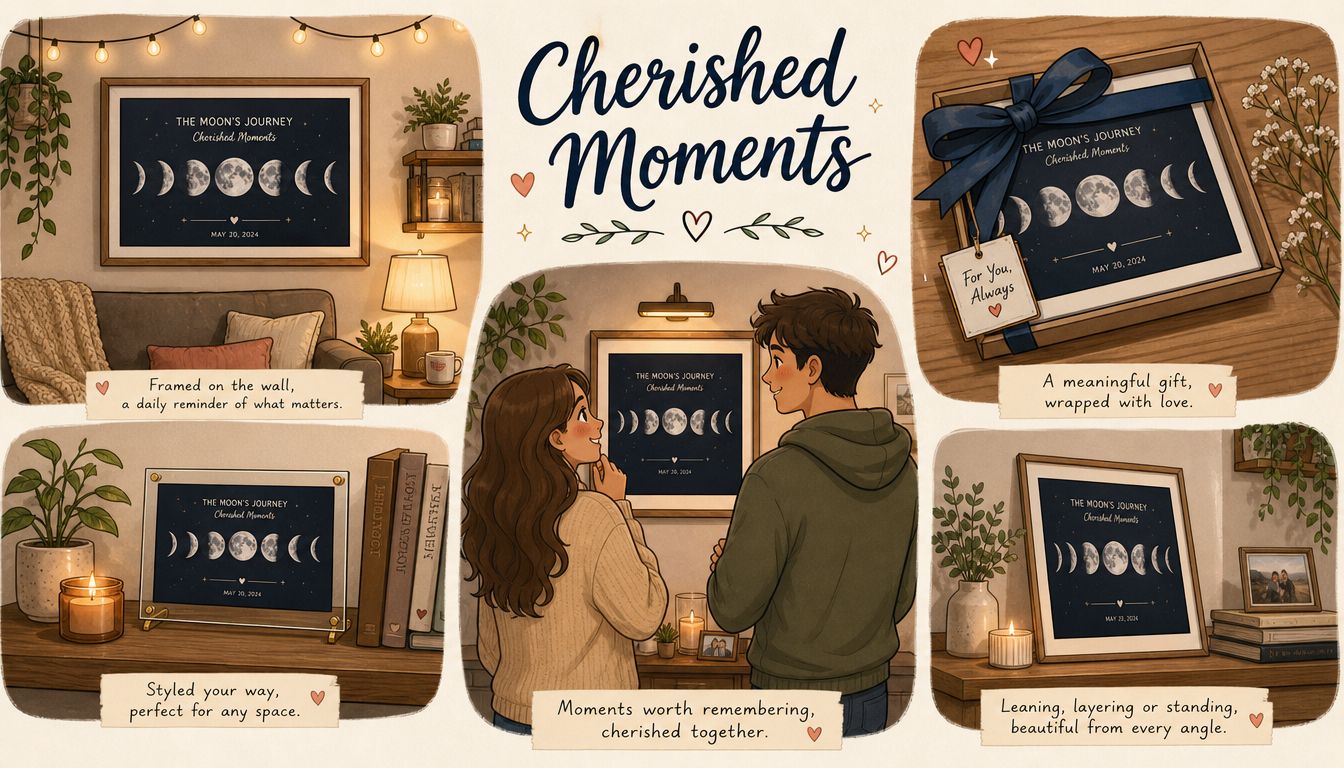
When this gift works especially well
A wedding gift is the obvious use case, but it's not the only strong one. New parents often love a print tied to a baby's birth date because it feels personal without becoming cluttered with stats and icons. For anniversaries, the piece works best when the date has a story attached to it, not just calendar importance.
I also like moon prints for quieter occasions. A first home together. The date of a reunion after distance. The night a family member arrived safely after a long wait. These moments don't always have standard gift categories, which is exactly why a personalized print feels thoughtful.
If you're building out a broader wedding or milestone gift plan, EasyRegistry for unique gifts offers helpful inspiration on where a personal art piece fits among more practical presents.
Frame choices that don't fight the art
The frame should echo the room, not overpower the print.
A thin black metal frame works well in modern apartments and with monochrome designs. Natural oak or light wood softens the print and suits Scandinavian, rustic, or warm neutral interiors. White frames can work in nurseries or airy spaces, but they need enough contrast against the wall to avoid disappearing.
A few practical pairings help:
- Black frame: strongest with dark or graphic layouts
- Natural wood: easiest for soft palettes and organic interiors
- White frame: best in bright rooms with muted wall color
- Wide mat border: useful when the print itself is visually minimal
For timing, production details matter if this is a gift. Revellia's production model uses local, on-demand printing with delivery typically within 3 to 7 business days, which helps when you need a personalized piece without a long lead time. That local printing approach also cuts down on unnecessary transport compared with a single centralized fulfillment route.
The final placement matters too. A moon print tends to work best where people pause. Bedside walls, hallways, above a dresser, or beside a reading chair usually feel better than cluttered corners where the piece has to compete with too many objects.
Common Questions About Custom Moon Prints
What happens if I enter the wrong location by mistake
Fix it as soon as you notice it. If the design is still in the editor, update the location and recheck the moon image and text before ordering. If the order has already been placed, contact the seller quickly because production may begin fast with print-on-demand workflows.
Can I create a print for a date in the future
Yes, if the tool allows future dates. Just be clear about what the print represents. For a future wedding or planned event, the piece becomes a symbolic gift until the date arrives.
Will the print show the moon as seen from the Southern Hemisphere
That depends on how the provider handles astronomical rendering. If hemisphere perspective matters to you, check whether the design reflects viewing orientation for the entered location rather than using a generic moon graphic.
Can I change my design after placing an order
Usually only if production hasn't started yet. Review names, dates, and spelling carefully before checkout. Personalized prints move quickly once they enter the print queue.
What if I only know the date but not the exact event time
Use the most honest estimate you can and keep the rest of the details precise. The date and location still carry most of the meaning, and an approximate time is better than invented certainty.
If you want a moon print that feels personal in both design and data, Revellia is one place to create it with an in-browser editor and customize the details around your date, text, and style. The best result comes from treating it as both a memory piece and a piece of home decor.